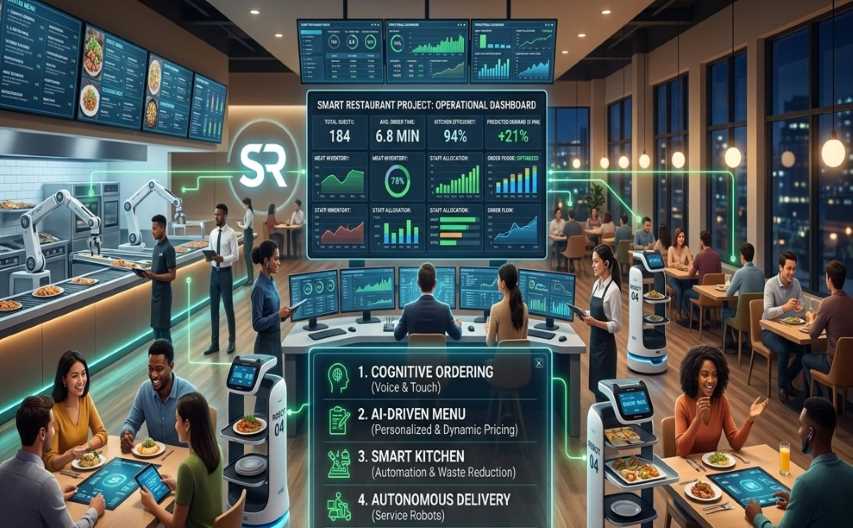
🤔 What is a Smart Restaurant Project?
A smart restaurant project refers to the integration of connected digital tools, devices, and software platforms that enable kitchens and dining rooms to operate more efficiently, intelligently, and seamlessly. It transforms a traditional eatery into an interconnected ecosystem where Artificial Intelligence (AI), the Internet of Things (IoT), automation, and cloud-based systems work together to enhance every facet of the operation—from kitchen workflows and inventory management to customer ordering and personalized dining experiences.
At its core, a smart restaurant is more than just adopting a single piece of technology. It involves building an integrated digital backbone—often called a Smart Restaurant Management System (SRMS)—that connects the front of house (ordering, payments, customer engagement) with the back of house (inventory, kitchen displays, equipment monitoring). This unified approach creates a continuous loop of real-time data that informs better decisions, reduces waste, and delivers a consistently high-quality guest experience.
✨ The Driving Forces: Why Go Smart?
The restaurant industry is undergoing a technological revolution as it faces persistent challenges: labor shortages, rising operational costs, thin profit margins, and evolving customer expectations. By 2026, AI had already evolved from a futuristic concept into an essential operational tool for modern restaurants, and this trend is accelerating rapidly.
The benefits are substantial and measurable. Restaurants leveraging AI at scale are seeing:
Metric | Typical Improvement |
|---|---|
Food waste | 30–50% reduction |
Labor costs | 10–20% decrease |
Inventory turnover | 15–25% improvement |
Average ticket size | 15–20% increase |
Order accuracy complaints | Over 400% reduction (near elimination) |
Guest wait times | Up to 38% shorter |
Smart kitchen equipment like automated fryers or robotic prep stations can handle repetitive, manual tasks, delivering consistent quality while dramatically reducing labor needs. For context, Chef José Andrés' ThinkFoodGroup implemented AI-powered scheduling across their restaurant portfolio, resulting in a 12% reduction in labor costs while maintaining service standards. The global smart fitness market is projected to reach $12.34 billion by 2032, reflecting the massive shift toward automation across the hospitality industry.
🛠️ Core Technologies of a Smart Restaurant
A smart restaurant integrates several key technologies that work in harmony to create a seamless, data-driven environment.
📱 Front-of-House (FOH) Technologies
QR Code Ordering & Digital Menus
Customers scan a QR code at their table to instantly access a digital menu on their smartphones, browse items, customize orders, and pay—all without waiting for a server. This contactless approach offers several advantages:
Instant menu updates: Change prices, add specials, or remove sold-out items in real-time.
Reduced wait times: Guests order when ready, directly routing requests to the kitchen display system (KDS).
Increased average check: Digital menus can suggest add-ons automatically, boosting per-ticket value.
Self-Service Kiosks
Touchscreen kiosks allow customers to browse the menu, customize orders, and pay independently. Cloud-based solutions like Deliverect Kiosk enable real-time menu management across all locations and support multilingual ordering, loyalty programme integration, and promotions. RestroGO's self-service kiosk software lets customers earn and redeem loyalty points directly through the interface, seamlessly integrating with existing POS systems. AI-powered kiosks can provide personalized upselling suggestions, increasing average order value by up to 20%.
AI-Powered Voice Ordering
Voice AI systems handle high-volume routine phone calls. Donatos Pizza implemented Revmo AI voice ordering and reclaimed 4,840.8 hours in a single month—roughly 30 full-time equivalent months—redeploying staff to focus on food quality and customer service. Jack in the Box deployed Qu across 2,100 restaurants in just 15 months, training staff 50–60% faster with an intuitive interface that crews could learn before their first lunch rush.
AI Chatbots & Virtual Assistants
Chatbots integrated into websites and social media handle basic customer inquiries, take reservations, answer FAQs, and even process orders, freeing human staff for more complex interactions.
🍳 Back-of-House (BOH) Technologies
Kitchen Display Systems (KDS)
A digital KDS replaces paper ticket systems, displaying orders in real-time on large screens. Lightspeed's next-generation KDS helps restaurants stay on top of orders, optimize workflows, and reduce both paper and food waste by automating order accuracy. Orders are automatically prioritized and managed to ensure timely completion, and the system integrates with POS and front-of-house ordering channels.
AI-Powered Kitchen Automation
Robots and AI-driven machinery are transforming food preparation:
Cooking robots: BOTINKIT's AI Food Hub, powered by its proprietary Restaurant-LM, automates menu planning, production scheduling, cooking execution, and procurement forecasting.
Fully automated kitchens: Circus developed a cooking robot (CA-1) that prepares entire meals—from measuring ingredients to cooking, plating, and even washing dishes.
Generative AI chefs: Nala Robotics uses ChatGPT to enable its autonomous chefs to prepare almost any recipe, addressing labor turnover and shortages.
Smart Inventory & Waste Management
IoT sensors track ingredient levels in real-time, preventing stockouts and reducing food waste. Qu's Smart Kitchen platform fuses IoT sensors, energy and equipment management, and predictive insights to maximize efficiencies and decrease costs. PreciTaste uses machine vision cameras to capture 3D dimensional data for measuring ingredients, enabling precision inventory tracking that minimizes food waste. Leanpath's touchless AI floor scale uses embedded machine vision to instantly record waste items and provide actionable data for reduction strategies.
🌍 The IoT & AI Backbone
The unified IoT infrastructure transforms disparate kitchen components (ovens, fryers, refrigerators, prep stations) into a single, intelligent network. Key features include:
Energy intelligence: Monitoring real-time energy consumption and automatically adjusting settings for efficiency.
Predictive maintenance: Detecting early signs of equipment failure before breakdowns occur, preventing costly downtime.
Real-time equipment monitoring and alerts: Providing instant notifications when appliances deviate from optimal parameters.
Shanghai's forward-looking action plan provides a glimpse of the future: by 2028, the city aims for smart technology integration to exceed 70 percent across the entire chain for group catering, fast-food, and beverage shops, with enterprises adopting smart beverage machines, frying robots, and burger assemblers.
🤖 Robotics & Autonomous Systems
Robotic Servers & Bussers
Autonomous robots deliver food to tables and clear dishes, allowing human staff to focus on more personalized guest interactions. While still emerging in Western markets, robotic servers are already widespread in Asia and are gradually being adopted globally.
Fully Autonomous Kitchens
Appetronix offers fully-autonomous kitchens that operate 24/7 with zero staff, integrating robotics, AI, and advanced systems engineering. Powered by Viam's AI platform, the system enables real-time food quality monitoring, predictive maintenance, and smart inventory management. Rolo Robotics raised $3.4 million for its autonomous kiosk that prepares made-to-order meals—customizable with adjustable sauce, seasoning, and crispiness—powered by multi-nozzle dispensers, real-time heat control, and AI-driven sensors, all remotely managed for consistency and safety.
📦 Delivery & Logistics Innovations
Drone Delivery
Olo, a restaurant technology provider serving over 750 brands, partnered with Zipline to integrate autonomous drone delivery capabilities into its platform, launching in 2026. Flipdish partnered with Manna to enable customers to order via an app while Manna's autonomous drones complete ultra-fast deliveries. GoTo Foods is piloting multi-brand drone delivery with DoorDash and Wing in three Texas markets, exploring how the technology can improve last-mile delivery efficiency.
Delivery Management Platforms
Integrated platforms allow restaurants to manage traditional and autonomous delivery channels from a single source, simplifying operations as they adopt next-generation logistics solutions.
📊 Data & Personalization
Customer Analytics & Personalization
AI-powered systems analyze customer data to deliver tailored experiences. The "Wisdom Restaurant" project uses AI visual recognition to identify customer characteristics (age, gender, group size) and provide personalized dish recommendations in real-time. TabSquare offers AI-powered digital ordering that provides personalized upselling suggestions, boosting sales while streamlining operations.
Edge AI & Privacy by Design
A major 2026 trend is "Privacy by Design"—Edge AI processing that keeps sensitive customer data local, directly addressing GDPR/CCPA compliance concerns.
🏗️ Types of Smart Restaurant Models
Type | Description | Best For | Example |
|---|---|---|---|
| Traditional + Smart Upgrades | Existing restaurants integrate selected technologies (QR ordering, KDS, AI scheduling) without complete overhaul. | Most existing restaurants, chains, independents. | Taco John's deploying kiosks and voice AI. |
| Fully Autonomous / Unstaffed | Zero human staff; AI, robotics, and IoT handle ordering, cooking, payment, and cleaning. | High-traffic urban areas, 24/7 operations, cost-sensitive models. | Appetronix autonomous kitchen; Rolo Robotics kiosk. |
| Ghost / Virtual Kitchens | Delivery-only operations using AI for demand forecasting, inventory, and routing optimization. | Delivery-focused brands, multi-brand operators. | Many cloud kitchen operators worldwide. |
| Unattended Smart Cafeterias | Automated serving systems using smart fridge technology, AI, and grab-&-go systems. | Corporate cafeterias, hospitals, universities. | Bob Bistro's fully automated smart fridge system. |
| AI-Powered Fast Casual | High levels of automation (voice ordering, robotic meal assembly, AI-driven upselling) in fast-casual format. | QSR and fast-casual chains. | McDonald's, Jack in the Box, White Castle testing robotics. |
🏢 Real-World Smart Restaurant Projects
| Project / Initiative | Organization / Location | Key Focus | Impact / Status |
|---|---|---|---|
| Chef Robotics at Cafe Spice | Cafe Spice (USA) | Automated meal assembly lines | Reduced dedicated workers per line to 3-4 people; tackled $15 minimum wage challenges. |
| ThinkFoodGroup AI Scheduling | Chef José Andrés (USA) | AI-powered labor optimization | 12% reduction in labor costs while maintaining service standards. |
| Donatos AI Voice Ordering | Donatos Pizza (USA) | Automated high-volume phone orders | Reclaimed 4,840.8 hours in a single month (≈30 FTE-months). |
| Jack in the Box Technology Rollout | Jack in the Box (USA) | Unified tech platform across 2,100 restaurants | Trained staff 50–60% faster; maintained operations even during outages. |
| Shanghai "AI + Dining" Pilot | Shanghai Municipal Government (China) | Build smart kitchen systems and promote AI solutions | Targeting 70% smart tech integration across chain restaurants by 2028. |
| BOTINKIT AI Food Hub | BOTINKIT (Global) | Proprietary Restaurant-LM with AI agents and certified cooking robots | Automates menu planning, production scheduling, cooking, and procurement. |
| Greenr Cafe | Greenr Cafe (India) | Smart scaling with Restroworks platform | Scaled from one location to seven outlets across four cities. |
| Taziki's Mediterranean Café | Taziki's (USA) | Data visibility and decision-making transformation | GM admin time reduced by 50%; inventory processes reduced from 6 hours to 2-3 hours. |
| Rolo Robotics Autonomous Kiosk | Rolo Robotics (Global) | Staff-free, made-to-order meal kiosk | Raised $3.4 million; features adjustable sauce, seasoning, and crispiness. |
🧠 Common Questions About Smart Restaurants
❓ How much does it cost to implement a smart restaurant?
Costs vary dramatically based on scale. Entry-level solutions (QR ordering + basic KDS) can cost a few hundred dollars per month. Mid-tier integration (kiosks, AI scheduling, inventory management) ranges from 5,000to5,000to50,000. Full autonomous kitchen systems may exceed $200,000. However, the return on investment typically justifies the expenditure.
❓ Will robots replace all restaurant jobs?
No. Automation handles repetitive, high-volume tasks (order taking, food assembly, dishwashing), freeing human staff to focus on higher-value activities: crafting complex dishes, providing genuine hospitality, handling personalized service, and managing unique guest situations. The future is human plus machine, not human versus machine.
❓ Is there a risk that technology will break and disrupt service?
Yes, which is why unified platforms and robust IT support are essential. Solutions like ScreenConnect enable remote monitoring and management, allowing technicians to troubleshoot and resolve issues without physical visits. Many smart restaurants maintain manual backup systems for critical operations.
❓ How do I start building a smart restaurant?
Start with one high-impact area: implement QR ordering to reduce server wait times, add a KDS to eliminate paper tickets, or deploy AI scheduling to optimize labor. Measure the results, then expand systematically. A piecemeal approach often works better than a full-scale, high-cost "big bang" rollout.
🔐 Challenges and Considerations
💰 High Initial Investment
The upfront cost of smart equipment (robots, sensors, kiosks), software platforms, and staff training can be substantial, particularly for smaller restaurants. However, operators report clear ROI typically within 12–24 months through savings on labor, waste, and energy.
🔒 Data Security and Privacy
With an average data breach cost of 4.88million (2024), and restaurant breaches sometimes exceeding 100 million when factoring in regulatory fines and legal settlements, cybersecurity cannot be an afterthought. Over 30% of hospitality businesses suffered at least one cyberattack in 2025, with breaches costing upwards of $3.4 million each. Common threats include AI-powered phishing and social engineering, where hackers clone voices to impersonate managers or suppliers.
🔗 Integration with Legacy Systems
Many restaurants already have investments in traditional equipment that isn't designed to be "smart." Retrofitting legacy systems with IoT sensors and connecting them to modern cloud-based platforms is often the biggest technical hurdle. Integration challenges are a primary reason some SaaS solutions fail to deliver promised operational improvements.
👨🏫 Staff Training and Change Management
Technology is only effective if people use it. Kitchen and service staff may resist new workflows, especially if they perceive the technology as complex or threatening. Successful implementations require comprehensive training, user-centered design, and clear communication about how technology supports employees rather than replacing them.
⚖️ Digital Divide and Customer Acceptance
Not all customers enjoy self-service kiosks, QR code ordering, or automated interactions. Older diners or those uncomfortable with technology may feel alienated. Smart restaurants balance their high-tech offerings with traditional service options to ensure inclusivity.
🔮 The Future of Smart Restaurants
The smart restaurant market is projected to exceed $1 billion in 2026, growing at a 16.39% compound annual growth rate. Several key trends are shaping its future:
🧠 Agentic AI & Autonomous Decision-Making
Instead of simply following pre‑programmed rules, AI "agents" will independently manage workflows. BOTINKIT's Restaurant-LM already automates full foodservice workflows using AI agents—from menu planning and procurement to cooking execution. The future points to AI making real-time operational decisions without human intervention.
"Privacy by Design" with Edge AI
Processing sensitive customer data locally on devices (Edge AI) rather than sending it to a central cloud server reduces legal and security risks. Edge AI also reduces latency, enabling real-time Personalization without the privacy headaches of big data centralisation.
🧩 Unified Platforms & Consolidation
Smaller point solutions are being acquired by larger platforms, or they pivot to a platform model. The big 2026 trend is kiosks talking to mobile apps and kitchen display systems as "one single brain" rather than separate silos.
📈 Predictive Demand & Radical Menu Simplification
Advanced AI systems will predict demand at the ingredient level, automating prep times and labor allocation accordingly. Simultaneously, smart brands are getting more rigorous about identifying high-value menu items—those that drive repeat visits and guest lifetime value—leading to radically simplified, more profitable menus.
🚁 Mainstream Drone Delivery
With Olo and Zipline's integration launching in early 2026 and multi-brand pilots underway, drone delivery is moving from experimental to mainstream, promising delivery times measured in minutes rather than hours.
🏁 A Smart Restaurant Project represents far more than a technology upgrade—it is a fundamental reimagining of how food service operates. By weaving together AI, IoT sensors, robotics, cloud-based management, and data analytics, smart restaurants create environments where waste is minimized, costs are controlled, safety is enhanced, and every guest receives a consistent, personalized experience.
The journey is not without its challenges: data security, integration costs, and staff training remain significant hurdles. However, the real-world examples showcased here—from Donatos reclaiming thousands of labor hours to Jack in the Box training staff 60% faster—demonstrate that these challenges are surmountable.
For any restaurant owner or operator looking to the future, the question is no longer "Should I go smart?" but rather "How quickly can I start?" The technology is mature, the use cases are proven, and the return on investment is clear. The restaurant of tomorrow—efficient, sustainable, hyper-personalized, and deeply connected—is being built today, one smart decision at a time. The future of dining is intelligent.
 |  |  |
 |  |  |