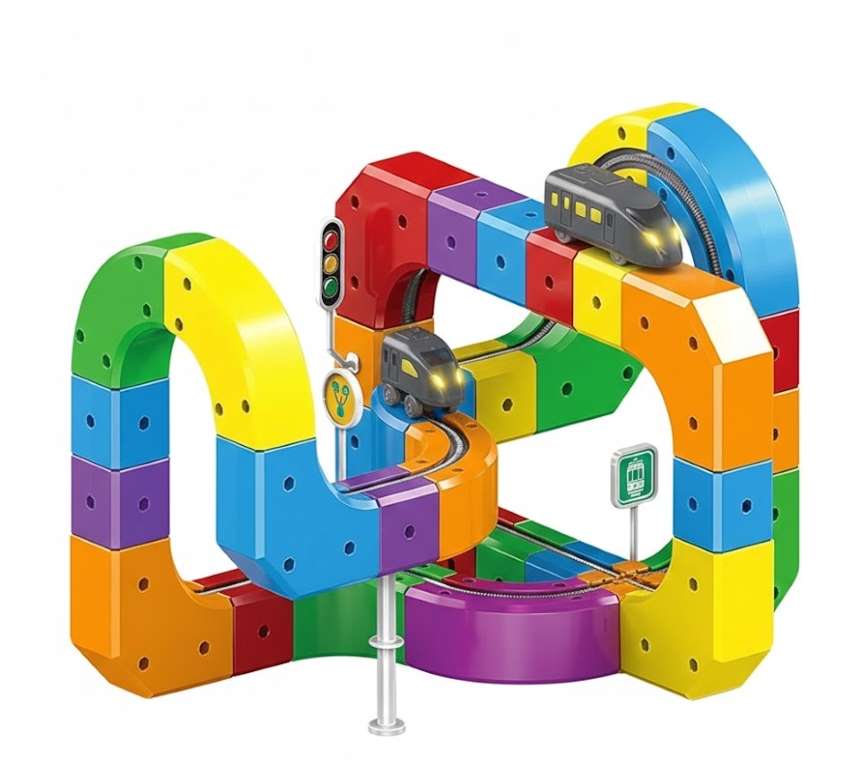
The Allure of Invisible Force
Magnetic Track Car Toys are a captivating category of educational and recreational toys that utilize the fundamental principles of magnetism—specifically magnetic attraction and repulsion—to propel specially designed vehicles along a guided track. Unlike traditional push-or-pull toys or battery-powered racers, these systems create a mesmerizing, seemingly magical experience where cars glide, race, and perform stunts using invisible magnetic forces. They engage children and adults alike, blending imaginative play with foundational lessons in physics.
Core Scientific Principle: How Magnetic Propulsion Works
The operation hinges on a simple yet ingenious application of magnetic poles.
The Law of Magnets: Like poles repel (North-North, South-South), and opposite poles attract (North-South).
Applied Design: The track contains embedded magnets with their poles oriented in a specific, consistent direction. The car also contains one or more magnets.
The Propulsion Mechanism:
Repulsion-Based Launch (Most Common): When the car is placed on the track, the like poles of the track magnet and car magnet face each other, creating a repulsive force. This force is contained by the track's walls, channeling it into forward motion, effectively "pushing" the car along its path.
Attraction-Based Systems: Some sets use attraction, where the car is "pulled" along by magnets in the track or by a magnetic wand controlled by the user.
Key Components & System Architecture
Component | Description & Function | Typical Materials |
|---|---|---|
| The Track | The guided pathway. Features a central channel for the car and integrated magnets. Designs include straight pieces, curves, loops, ramps, and stunt pieces. | Durable plastic (ABS), sometimes with rubberized coatings. Magnets are neodymium (rare-earth) for strong force. |
| The Car/Vehichle | A lightweight, low-friction vehicle containing one or more powerful magnets aligned to interact with the track. Often sleek and aerodynamic. | Plastic shell, metal axles, rubber or plastic wheels. Internal neodymium magnets. |
| Launcher/Booster | A separate device used to introduce the car onto the track with precise orientation and initial velocity, ensuring optimal magnetic engagement. | Plastic with a strong magnet and a spring or pull-back mechanism. |
| Support Structure | Columns, stands, and connectors that allow for vertical, multi-level track construction, enabling complex layouts and gravity-powered drops. | Interlocking plastic pieces. |
| Accessories | Gates, intersections, battery-powered booster stations, sound effect modules, and decorative elements that enhance play. | Various plastics and electronic components. |
Types & Variations of Magnetic Track Systems
Speed & Racing Sets: Focus on high-velocity straightaways, banked turns, and head-to-head multi-lane racing. Often include timers and finish line gates.
Stunt & Challenge Sets: Feature loops (loop-the-loops), corkscrews, suspension bridges, vortex funnels, and jump tracks where cars defy gravity.
Construction & Engineering Sets: Emphasize creative building, with a large number of track pieces allowing for endless custom configurations, from simple ovals to elaborate, roller-coaster-like towers.
Theme-Based Sets: Incorporate popular character licenses (like cars, superheroes) or real-world racing themes (Formula 1, rally).
Age & Complexity Tiering:
Beginner (Ages 3-5): Simple, large, snap-together tracks focused on cause-and-effect. Fewer small parts.
Intermediate (Ages 6-9): More complex pieces like loops and risers. Introduces basic physics concepts.
Advanced (Ages 10+): Intricate construction sets with hundreds of pieces, focused on engineering challenges and kinetic sculpture.
Educational & Developmental Benefits
STEM Learning (Hands-On Physics): Demonstrates core concepts of magnetism, kinetic and potential energy, momentum, gravity, centrifugal force, and friction in an intuitive, experiential way.
Spatial Reasoning & Engineering: Building 3D track layouts develops planning, structural understanding, and problem-solving skills when designs fail and need troubleshooting.
Fine Motor Skills & Dexterity: Connecting track segments, placing supports, and launching cars require precise hand-eye coordination.
Cognitive Development: Encourages logical thinking, sequential planning, and understanding of cause-and-effect relationships.
Creative Play & Imagination: Beyond prescribed layouts, children create their own tracks, narratives, and racing scenarios, fostering creativity and storytelling.
Selection Guide: Choosing the Right Set
Consideration | Key Questions | Recommendations |
|---|---|---|
| Child's Age & Skill | Is it for a preschooler or a tinker-loving older child? What is their dexterity level? | Match complexity to age. Start with beginner sets to build confidence and avoid frustration. |
| Play Value & Expandability | Does the set offer multiple configurations? Can you buy expansion packs later? | Choose core sets from major brands (Magna-Tiles® Trexo, Magformer, Playmobil) with available add-ons. |
| Quality & Safety | Are the magnets securely sealed? Is the plastic durable and free of sharp edges? | Prioritize sets where magnets are fully encapsulated to prevent choking hazards. Look for robust, thick plastic. |
| Primary Interest | Is the child more interested in racing, performing stunts, or building structures? | Racing sets have lanes and timers. Stunt sets have loops and jumps. Builder sets have more connectors and supports. |
| Storage & Space | How many pieces are there? Does it come with a storage container? How much room is needed for assembly? | Consider footprint. Large roller-coaster sets can dominate a room. Look for stackable or bin-friendly pieces. |
Operation, Play & Maintenance Tips
Optimal Launch Technique: Use the provided launcher. Ensure the car is oriented correctly (usually with a specific symbol or color facing forward) so the magnetic poles align for repulsion. A smooth, straight launch is key.
Track Construction Basics: Build on a flat, stable surface. Ensure all connections are "clicked" securely to prevent collapses. For tall structures, ensure the base is wide enough for stability.
Troubleshooting Common Issues:
Car Stopping: Check for dirt on wheels or track. Ensure magnets in car and track are clean and undamaged. Verify correct car orientation.
Car Derailing: Check that track joints are perfectly aligned. Slow the car's launch speed on tricky stunts.
Weak Propulsion: Check for opposite-pole attraction (car stuck). Flip the car. Ensure launcher magnet is strong.
Cleaning & Care: Wipe tracks with a dry or slightly damp cloth. Keep magnets away from dust and metallic debris. Store in a cool, dry place to prevent plastic warping. Crucially, keep all magnets far away from electronics, credit cards, and pacemakers.
More Than Just a Toy
A Magnetic Track Car system is a dynamic portal into the invisible forces that govern our physical world. It transforms abstract scientific concepts into tangible, thrilling experiences. The satisfying click of track connections, the whirring silence of a car speeding through a loop, and the triumphant crash of a successful jump create a deeply engaging play cycle. It is a toy that grows with a child, evolving from simple pushing to complex engineering, making it a timeless and valuable investment in fun and learning.
 |  |  |
 |  |  |