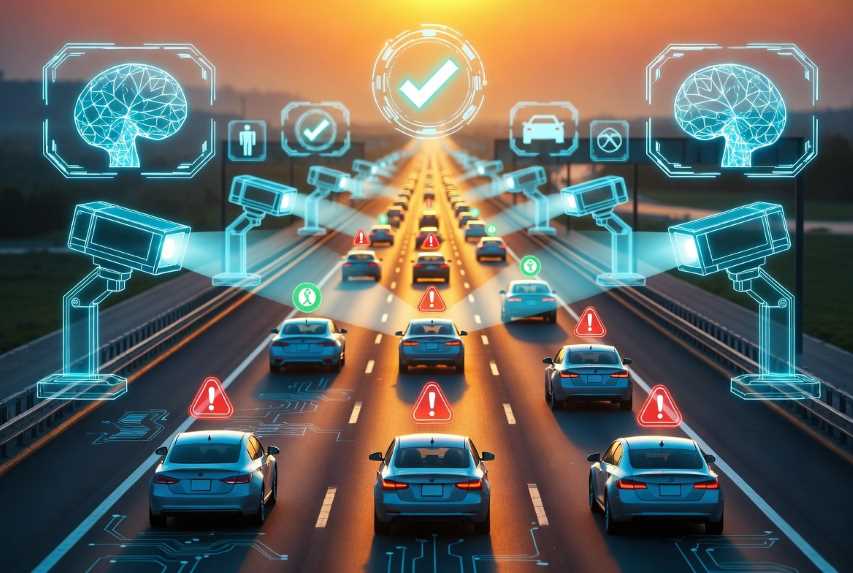
Traffic violations claim over 1.3 million lives globally each year and injure millions more. Traditional enforcement—police patrols, fixed speed cameras, and manual checks—is reactive, limited in scale, and often fails to deter dangerous behavior before it occurs. Artificial intelligence is changing this landscape by shifting the paradigm from punishment after the fact to real‑time prevention. By combining computer vision, sensor fusion, predictive analytics, and instant feedback loops, AI systems can detect, alert, and even stop violations before they happen, making roads dramatically safer.
How AI Detects and Predicts Violations
Modern traffic‑prevention AI rests on three pillars:
Computer Vision and Deep Learning
High‑resolution cameras mounted on infrastructure, patrol vehicles, and drones continuously scan the roadway. Convolutional neural networks (CNNs) and transformer‑based models identify vehicles, pedestrians, cyclists, lane markings, traffic signs, and signals in real time. The system tracks trajectories, calculates speeds, and recognizes behaviors like:
Running a red light or stop sign
Illegal U‑turns or lane changes
Failure to yield to pedestrians
Driving the wrong way on a one‑way street
Distracted driving (e.g., phone use) and seat‑belt non‑compliance
Because these models are trained on millions of labeled examples under varied weather and lighting conditions, they can spot infractions with accuracy often exceeding human observers.
Multi‑Sensor Fusion
Radar, LiDAR, and acoustic sensors complement cameras. Radar accurately measures speed in rain or fog; LiDAR builds precise 3D maps of the environment; microphones detect engine revving indicative of street racing or aggressive acceleration. AI fuses these streams to confirm a violation from multiple angles, reducing false positives. For instance, a potential red‑light violation is validated by cross‑referencing the traffic signal’s phase (which can be read by a dedicated short‑range radio or optically) with the vehicle’s speed and position from radar.
Predictive Analytics and Behavioral Modeling
Historical violation data, time of day, road geometry, weather, and even social‑media event feeds are fed into machine‑learning models that forecast where and when violations are most likely. A city can then dynamically deploy mobile AI units or adjust signal timing to preempt risky situations. On a microscopic level, in‑vehicle AI (or edge devices at intersections) can predict that a driver approaching a stale green light too fast will likely run the red, triggering an extension of the all‑red clearance interval or an in‑car alert.
Key Applications of AI in Violation Prevention
Domain | AI Intervention | Prevention Mechanism |
|---|---|---|
| Speeding | Average‑speed cameras with ANPR; adaptive speed‑limit signs linked to congestion/weather AI | Real‑time, dynamic speed limits and gentle in‑car warnings before a driver exceeds them; section control that rewards steady, legal speeds over an entire corridor. |
| Red‑Light & Stop‑Sign Running | Intersection AI boxes with edge processing | When a vehicle’s deceleration profile suggests it will not stop, the system can hold the conflicting green phase for an extra second, flash a warning on an overhead sign, or send a signal to the car’s collision‑avoidance system. |
| Impaired Driving | In‑cabin driver‑monitoring cameras using infrared and AI | Micro‑sleep detection, gaze tracking, and erratic steering patterns trigger seat vibrations, audio alerts, and a gradual reduction of vehicle speed. Future systems may lock the ignition if a breath‑analyzer or camera‑based intoxication score exceeds a threshold. |
| Distracted Driving | Roadside AI cameras + in‑vehicle monitoring | Roadside units detect a driver holding a phone; in real time, a connected sign displays the license plate with a warning. The car’s own AI simultaneously disables infotainment functions. |
| Aggressive Driving & Street Racing | Acoustic gunshot‑like sensors and trajectory analysis | Neural networks recognize the sound signature of racing engines and tire squeals. Police are automatically dispatched, and variable message signs display targeted warnings to the vehicles involved. |
| Pedestrian Right‑of‑Way Violations | AI‑enabled crosswalks | Cameras predict a pedestrian’s intent to cross and can activate flashing beacons, extend walk signals, or trigger a warning on a connected vehicle’s dashboard. Vehicles that fail to yield are identified and receive an immediate audio‑visual alert. |
| Commercial Vehicle Violations | Weigh‑in‑motion sensors + AI image analysis | Overloaded trucks are identified without stopping; AI checks for tire defects, unsecured loads, and driver fatigue. The vehicle can be directed to a rest area before a violation turns into a crash. |
Real‑Time Prevention: Closing the Loop
The most transformative aspect of AI is its ability to intervene in the seconds before a violation occurs. The loop works as follows:
Sense – Multi‑modal sensors capture the scene.
Interpret – AI classifies the event, evaluates risk, and predicts the next few seconds.
Decide – An edge‑computing node selects the least intrusive yet effective intervention: a visual warning, an auditory signal, a haptic steering‑wheel nudge, or a vehicle‑to‑infrastructure command.
Act – The signal is delivered either through road‑side displays, connected‑vehicle communication (C‑V2X), or smartphone apps (e.g., navigation apps that display “slow down – school zone ahead” with a voice prompt).
Learn – The outcome is logged, and the system continuously refines its models to reduce false alarms and improve timing.
This closed‑loop approach moves enforcement from the punitive to the preventive, reducing the adversarial relationship between drivers and traffic authorities.
Benefits Beyond Safety
Reduced Congestion: Smoother traffic flow results when AI minimizes sudden braking and collision‑related lane closures. Adaptive signal control that prioritizes compliance also trims idling time.
Lower Emissions: Consistent speeds and fewer stops cut fuel consumption and CO₂ output.
Equity: Automated, data‑driven enforcement removes the potential for human bias in traffic stops, provided the AI is trained on diverse datasets and routinely audited.
Resource Optimization: Law enforcement can focus on serious crime rather than routine traffic patrol, and city budgets see long‑term savings from crash reduction.
Data‑Driven Infrastructure Planning: Violation heatmaps reveal dangerous intersections, guiding engineering countermeasures like roundabouts, speed humps, or improved signage.
Challenges and Considerations
Privacy
Continuous monitoring raises legitimate concerns. Solutions include on‑edge processing where video is analyzed locally and only anonymized violation metadata is transmitted, strict data retention policies, and independent oversight committees. Legislation such as GDPR in Europe already mandates privacy‑by‑design in AI surveillance systems.
Bias and Fairness
If training data under‑represents certain vehicle types, skin tones, or neighborhoods, the AI may misidentify violations. Rigorous bias testing, diverse datasets, and transparent audit trails are essential. Some cities are adopting “algorithmic impact assessments” before deployment.
Technical Reliability
Adverse weather, sensor fouling, and adversarial attacks (e.g., stickers designed to confuse license‑plate readers) can degrade performance. Redundant sensors, regular maintenance, and continuous human‑in‑the‑loop validation mitigate these risks.
Public Acceptance
Drivers may resent constant oversight. Early public consultation, visible but non‑intrusive warnings (e.g., “AI speed check ahead” signs), and a grace period with educational notices instead of fines help build trust. When people realize the system is preventing crashes rather than just issuing tickets, acceptance grows.
Legal and Ethical Frameworks
Laws must evolve to define the admissibility of AI‑generated evidence, liability when an intervention fails, and standards for system certification. A clear chain of accountability—from developers to deploying agencies—is necessary.
The Road Ahead
The future of AI‑driven traffic violation prevention is deeply integrated with autonomous and connected vehicles. Cars will receive real‑time behavioral guidance from the cloud, and vehicles themselves will become enforcement nodes, anonymously reporting road hazards and violations to a collective safety mesh. Smart cities will treat traffic safety as a system‑optimization problem, using reinforcement‑learning agents that balance throughput and risk, adjusting speed limits and signal phases by the second.
In the near term, expect to see:
Widespread deployment of AI at dangerous intersections, funded by safety grants.
Insurance companies offering premium discounts for drivers who opt into in‑car monitoring that prevents violations.
Cooperative ecosystems where navigation apps like Waze and Google Maps incorporate real‑time violation‑prevention nudges.
Mandatory in‑cabin monitoring in all new vehicles, not just for advanced driver‑assistance systems but for occupant safety, as already mandated by Euro NCAP and soon by regulators worldwide.
Artificial intelligence has the power to transform traffic enforcement from a retrospective, punitive system into a proactive guardian of road safety. By sensing the environment, predicting human error, and gently steering behavior in the right direction, AI can prevent countless tragedies. The technology is ready; the remaining work lies in crafting the legal, ethical, and social frameworks that ensure these systems are deployed transparently, equitably, and with the public’s trust. When that balance is struck, the vision of zero traffic fatalities—once utopian—becomes an achievable destination.
 |  |  |
 |  |  |