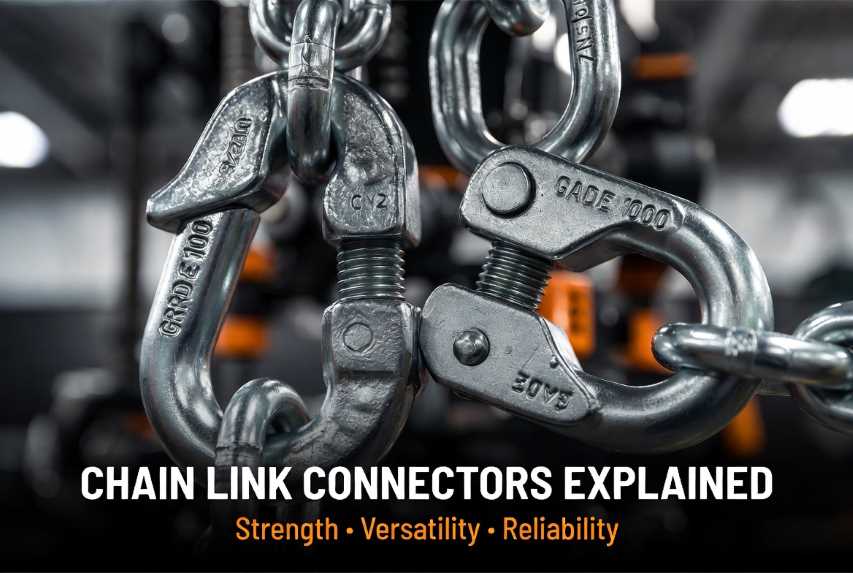
🤔 What Is a Chain Link Connector?
A Chain Link Connector (also known as a chain link, coupling, or master link) is a specialized hardware component used to join separate segments of a chain, connect a chain to other equipment, or facilitate easy assembly and disassembly for maintenance. These robust components serve as the critical link—literally—that holds your entire chain assembly together.
Think of them as the “missing links” that complete the loop. Whether you are repairing a snapped bike chain, extending a heavy‑duty lifting sling, or securing cargo on a trailer, the right chain link connector ensures that the load is transferred safely and reliably across the entire system.
✨ Why Quality Connectors Matter: The Core Benefits
🛡️ Safety and Load Integrity
The connector is often the weakest point in any chain assembly. Using a high‑quality, properly rated connector ensures that the connection does not fail under tension, preventing accidents, property damage, or personal injury.
🔧 Versatility and Modularity
Connectors allow you to modify the length of a chain, replace worn sections without replacing the entire chain, and attach accessories such as hooks, swivels, or shackles. This modularity saves time, money, and material.
⏱️ Easy Maintenance
For bicycle chains, quick links allow tool‑free removal for deep cleaning and lubrication, significantly extending the life of the drivetrain. In industrial settings, connecting links enable fast repair of conveyor or lifting chains without dismantling the entire system.
🌍 Adaptability to Environment
With options ranging from economical zinc‑plated steel to super‑corrosion‑resistant 316 stainless steel, connectors can be tailored to virtually any environment—from dry indoor workshops to harsh marine or chemical‑exposed locations.
🧩 Types of Chain Link Connectors
📦 Quick Links (Screw‑Lock Connectors)
These are the most common and versatile connectors. They feature a threaded sleeve that screws shut, securing the link. Quick links are available in oval, pear, triangle, and square shapes to accommodate different rigging and connecting needs. They are ideal for light to medium‑duty applications where frequent connection and disconnection are required.
🔗 C-Links (Connecting Links)
Also known as a standard connecting link, the C‑link is the traditional choice for permanently joining two chain lengths. When correctly peened (hammered closed), this connector is highly reliable and can last for years. C‑links are commonly used in anchor chains and permanent rigging assemblies where strength and longevity are paramount.
🔩 Spring Clip Connecting Links
Used extensively in roller chain power transmission (bicycles, motorcycles, industrial machinery), this type consists of a link with a spring clip that snaps over the outer plate. The open end of the clip must face away from the direction of chain travel to prevent the clip from being forced off during operation.
🔧 Cotter Pin Connecting Links
For high‑speed or high‑vibration applications where a spring clip might fail, cotter pin links provide a more positive retention. A cotter pin is inserted through the link pin to secure the outer plate, making this type suitable for heavy‑duty drives and shock‑loading conditions.
🛠️ Hammerlok Coupling Links
These heavy‑duty connectors are rated for overhead lifting and are used to construct lifting slings. They are forged from high‑grade alloy steel (Grades 80, 100, or 120) and feature a design factor of 4:1. They are not intended for chain repair but for assembling certified lifting assemblies.
⛓️ Double Clevis Links (Mid-Links)
These connectors consist of two clevis ends secured with pins and cotter pins. They offer strength comparable to the chain itself but generally cannot pass through chain handling equipment such as a gypsy (chain wheel) on an anchor windlass. They are common in transportation and towing applications.
🧲 Master Links
Master links are large, heavy‑duty connectors used as a central attachment point in complex rigging setups. They are designed to accommodate multiple chain legs or other rigging components, making them essential for multi‑leg lifting slings.
🌀 Offset (Half) Links
Also called half‑links, these allow the chain length to be adjusted by an odd number of pitches. This is crucial when the chain run cannot be made an even number of pitches using standard connecting links alone.
🧬 Materials & Durability: Choosing the Right Metal
The material of a chain connector directly determines its strength, corrosion resistance, and application suitability.
Material | Characteristics | Best For |
|---|---|---|
| Zinc‑Plated Steel | Most economical option; resists occasional moisture; strength comparable to standard carbon steel | Dry indoor applications, light‑duty repairs, general hardware use |
| Hot‑Dip Galvanized Steel | Thick zinc coating provides superior corrosion protection; withstands outdoor exposure | Marine anchor chains, outdoor rigging, agricultural use |
| Grade 30 / 70 Steel (Quick Links / Double Clevis) | Standard commercial grade for quick links; not rated for overhead lifting | General purpose, transportation, towing, non‑critical connections |
| Grade 80 / 100 / 120 Alloy Steel | Quenched and tempered alloy steel; design factor 4:1; suitable for overhead lifting | Lifting slings, heavy industrial rigging, certified overhead lifting |
| 304 Stainless Steel | Good corrosion resistance; less expensive than 316; suitable for food processing and mild chemical exposure | Food industry, pharmaceutical drives, general corrosive environments |
| 316 Stainless Steel | Superior resistance to salt water, harsh weather, and most chemicals; will not degrade in marine environments | Marine applications, coastal installations, chemical plants, outdoor year‑round use |
⚖️ Understanding Safety Ratings: WLL & MBL
When selecting a chain connector, two critical numbers determine its safe usage:
WLL (Working Load Limit): The maximum load that the connector is designed to handle during normal use. This is the number you must never exceed.
MBL (Minimum Breaking Load): The theoretical load at which the connector is expected to fail. This is for engineering reference only—never use this as a working limit.
For lifting and overhead applications, the safety factor is typically 4:1, meaning the MBL is four times the WLL. For example, a connector with a WLL of 2,000 kg has an MBL of 8,000 kg.
⚠️ Critical Safety Rule: Always select a connector that matches or exceeds the strength of the chain you are connecting. Never mix chain series—even if the pitch matches, pin diameter and plate width can differ, creating a dangerous weak point.
🛠️ How to Choose the Right Connector: A Decision Guide
Application | Recommended Connector Type | Material | Key Consideration |
|---|---|---|---|
| Bicycle chain repair / replacement | Spring clip connecting link (quick link) | Carbon steel or stainless | Match speed (8‑12 speed); reusable or single‑use types available |
| Motorcycle / industrial roller chain | Spring clip or cotter pin connecting link | Carbon steel or stainless | Spring clip for low‑speed; cotter pin for high‑speed (>15 m/s) |
| Anchoring / mooring chain (permanent) | C‑link (peened) | Hot‑dip galvanized steel | Must pass through gypsy; requires heavy hammer for installation |
| Anchor chain (temporary / removable) | Two rated shackles | Galvanized alloy steel | Pins must be moused (secured) to prevent loosening; stronger than the chain itself |
| Overhead lifting sling | Hammerlok coupling link (Grade 80/100/120) | Alloy steel, quenched & tempered | Use only for certified sling construction; never use quick links |
| Towing safety chains | Quick link or double clevis | Grade 70 steel | Must be rated for towing; inspect regularly for wear |
| Marine / outdoor exposure | 316 stainless steel quick link | 316 stainless | Superior corrosion resistance; will not degrade in salt water |
| Light‑duty / general repair | Zinc‑plated oval quick link | Zinc‑plated steel | Economical; suitable for dry, occasional use only |
📏 Step‑by‑Step Installation Guide
🔧 For Quick Links (Screw‑Type)
Align the chain ends or component holes with the open gap in the quick link.
Thread the sleeve closed by hand until the nut completely covers the threads. For larger links, use an open‑end wrench to tighten securely.
Verify that the nut fully covers the threads—this is essential to achieve the rated weight capacity.
Inspect the connection for any gaps or misalignment.
⛓️ For Spring Clip Connecting Links (Roller Chain)
Prepare the chain ends by cleaning any dirt or debris from the links.
Insert the connecting link pins through the two outer chain plates.
Place the outer plate over the pins and press it into position.
Secure with the spring clip, ensuring the open end of the clip faces away from the direction of chain travel. This prevents the clip from being forced off as the chain moves around sprockets.
Test the connection by rotating the chain slowly to ensure smooth operation.
🔨 For C‑Links (Permanent Connection)
Insert the C‑link through the two chain end links.
Place the C‑link on a solid anvil or heavy metal surface—never on deck or a surface that could be damaged.
Peen (hammer) the ends aggressively with a heavy hammer to close the link permanently. A proper peen creates a mushroomed end that prevents the link from opening.
Do not weld the joint, as heat will destroy the temper and weaken the steel.
Inspect regularly for corrosion, especially at the peened points where galvanizing may have been damaged.
🧼 Inspection & Maintenance
Regular inspection is essential for safety, particularly in critical applications such as lifting and towing. Industry standards recommend inspection at least every six months, or more frequently in severe operating conditions.
✔️ Pre‑Use Checklist
All markings are legible—grade and WLL should be clearly visible.
The connector is free from nicks, gouges, and cracks.
No deformation or distortion—the link should retain its original shape.
The locking mechanism (screw, pin, clip) is fully engaged and cannot vibrate loose.
The connector has not been heat‑treated after manufacture—field heat treatment destroys strength.
❌ Signs of Wear (Replace Immediately)
Visible cracks or pitting
Thread damage or stripping (on screw‑type links)
Bent or twisted shape
Corrosion that has penetrated the surface
Difficulty opening or closing the locking mechanism
Excessive wear (reduced cross‑sectional thickness)
🌍 Real‑World Applications
Chain link connectors are found in countless industries:
Maritime & Anchoring: Joining anchor chain shots, attaching swivels, and connecting mooring lines.
Construction & Lifting: Building multi‑leg chain slings, attaching hooks, and creating adjustable lifting assemblies.
Agriculture: Repairing manure spreader chains, securing gates, and fixing tractor implements.
Transportation & Towing: Connecting safety chains, securing cargo, and attaching tie‑downs.
Bicycling & Motorcycling: Quick chain replacement, tool‑free cleaning, and emergency roadside repairs.
Industrial Power Transmission: Conveyor systems, packaging lines, and heavy machinery drives.
🏁 A Chain Link Connector may be a small component, but its role in safety, efficiency, and reliability is immense. Whether you are a weekend cyclist, a commercial rigger, or a marina operator, understanding the different types of connectors—quick links, C‑links, hammerloks, spring clips, and more—ensures that you choose the right tool for the job.
Always prioritize safety: match the connector to the chain grade, never exceed the Working Load Limit, inspect regularly, and replace any component that shows signs of wear or damage. With the right connector properly installed, your chain system will deliver years of dependable, trouble‑free service.
 |  |  |
 |  |  |