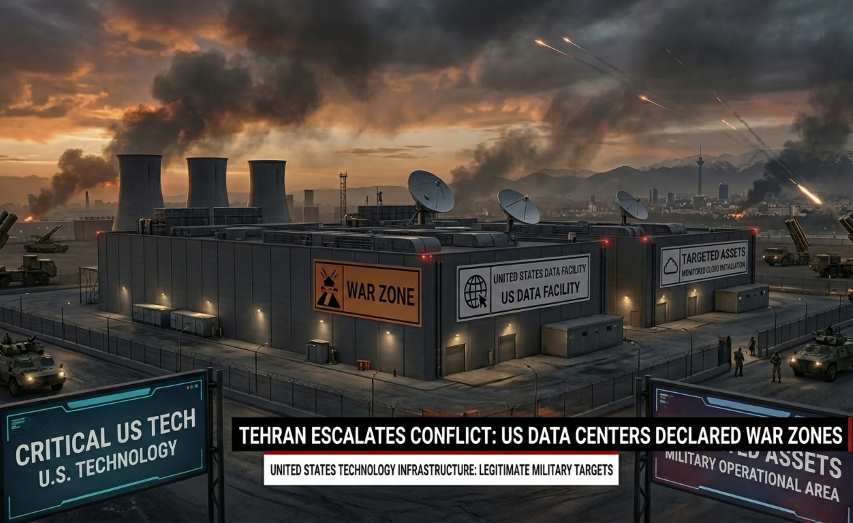
In a dramatic and deeply concerning escalation of the ongoing conflict involving Iran, the United States, and Israel, Iranian state-affiliated media outlets have officially designated the regional offices, data centers, cloud computing facilities, and related infrastructure of several prominent American technology companies as “legitimate military targets.” This announcement, which was disseminated through Tasnim News Agency—an outlet widely regarded as closely aligned with Iran’s Islamic Revolutionary Guard Corps—represents a calculated broadening of Tehran’s strategic approach. What was once limited to traditional military and governmental sites has now extended into the commercial digital realm, framing private-sector technology assets as fair game in what Iranian officials are calling an expanding “infrastructure war.”
The declaration, which surfaced prominently in mid-March 2026, explicitly names facilities operated by some of the world’s most influential technology firms. These include Google, Microsoft, Amazon, Palantir Technologies, Oracle, International Business Machines, and Nvidia, among others. The targeted sites are scattered across key locations in Israel, the United Arab Emirates, Bahrain, Saudi Arabia, and additional Gulf Cooperation Council nations. In these areas, American companies have poured billions of dollars into building expansive data centers, advanced research laboratories, artificial intelligence development hubs, and high-capacity cloud operations designed to fuel regional economic growth, digital transformation, and cutting-edge innovation in sectors ranging from finance to healthcare.
Iranian media presented the list of targets alongside provocative imagery and commentary that underscored the seriousness of the threat. Accompanying statements emphasized that “with the expansion of regional war dimensions into infrastructure, cyberwarfare, and scope, Iran’s legitimate targets are gradually expanding.” Officials in Tehran have argued that the technologies and services provided by these companies—such as powerful cloud computing platforms, artificial intelligence tools, advanced semiconductor chips, and sophisticated data analytics systems—have been actively supporting United States and Israeli military and intelligence operations. By integrating these assets into their broader conflict strategy, Iran appears determined to impose significant economic, operational, and psychological costs on Western powers that it accuses of backing its adversaries.
Deepening Context of Escalation and Retaliatory Actions
This latest move does not occur in isolation but builds upon a rapidly intensifying cycle of retaliation and counter-retaliation that has defined Middle Eastern geopolitics in recent months. The backdrop includes repeated United States and Israeli military strikes aimed at Iranian military installations, nuclear-related facilities, and economic assets. One particularly notable incident involved a reported strike on an Iranian financial institution, which reportedly disrupted salary payments to thousands of Islamic Revolutionary Guard Corps personnel and created internal logistical challenges for the regime.
In direct response, Iran has already demonstrated its willingness to strike at digital infrastructure. Iranian forces, utilizing drone technology, have conducted targeted attacks on Amazon Web Services data centers located in both the United Arab Emirates and Bahrain. These assaults resulted in visible structural damage, widespread power outages, and temporary disruptions to cloud-based services that support countless businesses, government agencies, and everyday users across the broader region. Security analysts have described these incidents as groundbreaking, marking the first time in modern warfare that private-sector hyperscale data centers—facilities once considered purely commercial and civilian in nature—have been deliberately targeted by state-sponsored military action.
The Islamic Revolutionary Guard Corps has consistently framed such operations as measured and proportional responses to what it characterizes as “unprovoked aggression” against Iranian sovereignty and regional interests. By publicly labeling commercial technology infrastructure as military objectives, Tehran is signaling a strategic pivot. This approach aims not only to disrupt immediate operations but also to deter further involvement by Western technology firms in projects that Iran perceives as bolstering its opponents’ capabilities. The move also reflects Iran’s growing emphasis on asymmetric warfare tactics, where economic and technological pressure points are leveraged alongside traditional military means to level the playing field against more conventionally powerful adversaries.
Far-Reaching Impact on Global Technology Infrastructure and Operations
The implications of Iran’s declaration extend well beyond the immediate conflict zone, threatening to reverberate through the global technology ecosystem. The affected facilities are far from peripheral outposts; many serve as vital nerve centers for international data processing, artificial intelligence model training, secure communications, and enterprise-level cloud services. These operations support not only local Middle Eastern clients but also extend their reach to users and organizations in Europe, Africa, and parts of Asia, making any disruption potentially catastrophic on a multinational scale.
For example, Amazon’s data centers in the Gulf region have already experienced direct hits from Iranian drone strikes, leading to service interruptions that affected everything from electronic commerce platforms to critical backup systems for financial institutions. Microsoft and Google maintain substantial cloud infrastructure and corporate offices in the United Arab Emirates and Israel, where they provide essential productivity tools, data storage solutions, and artificial intelligence services to governments and private enterprises alike. Nvidia operates a significant research and development presence in Israel, focusing on graphics processing units and artificial intelligence hardware that power advanced computing applications worldwide. Similarly, Palantir Technologies—renowned for its work in defense analytics—along with Oracle and International Business Machines, run regional operations deeply intertwined with high-performance computing and enterprise software solutions.
Experts from the cybersecurity and international relations fields have issued stark warnings about the potential fallout. Should Iran follow through with physical strikes, cyberattacks, or even sustained harassment campaigns, the consequences could include prolonged outages in financial services, healthcare record systems, logistics networks, telecommunications, and emergency response coordination. Pro-Iranian hacker collectives have already demonstrated their capabilities by claiming responsibility for various cyber incidents targeting United States-based firms, including a notable disruption at a major medical device manufacturer. These hybrid threats blend kinetic military action with digital sabotage, creating a multifaceted challenge for technology companies and their clients.
Moreover, the targeting of these assets could severely hamper ongoing advancements in artificial intelligence and cloud computing across the Middle East. Many of the region’s most ambitious digital transformation initiatives—smart cities, autonomous transportation systems, and precision healthcare—rely heavily on the very infrastructure now under threat. The economic ripple effects could be enormous, potentially slowing foreign investment, disrupting supply chains for semiconductors and related hardware, and forcing companies to divert resources toward emergency contingency planning rather than innovation.
Corporate Responses, International Reactions, and Heightened Security Measures
In the wake of the announcement, major United States technology companies have largely maintained a public stance of cautious silence, choosing not to comment directly on the specific threats in order to avoid further inflaming the situation. However, behind the scenes, several firms have moved swiftly to implement comprehensive protective measures. Reports indicate that companies such as Amazon, Google, Nvidia, and others have conducted urgent security audits, relocated non-essential personnel to safer locations or enabled full remote-work protocols in high-risk zones, and begun the complex process of hardening or temporarily scaling back operations at vulnerable sites. Some offices in the Gulf have reportedly been placed under enhanced physical security or even temporarily shuttered as a precautionary step.
On the international stage, the United States government has refrained from issuing an immediate public statement, though senior cybersecurity and defense officials are said to be closely monitoring developments in coordination with allies. Diplomatic channels are reportedly active, with discussions focusing on bolstering regional defenses and exploring options for de-escalation. Observers in the international community have highlighted the complex legal and ethical questions raised by this development, particularly under the framework of international humanitarian law. The targeting of dual-use infrastructure—that is, facilities with both civilian and potential military applications—tests longstanding norms regarding the protection of civilian assets during armed conflict and could set dangerous precedents for future disputes.
A Transformative Shift in the Landscape of Modern Warfare
Analysts across the globe are describing Iran’s declaration as a pivotal moment in the evolution of twenty-first-century conflict. In an era where digital infrastructure underpins nearly every aspect of modern society and military operations, data centers and technology hubs have transitioned from being viewed as neutral commercial entities to strategic vulnerabilities on the battlefield. The reliance of armed forces on artificial intelligence for intelligence analysis, secure communications, predictive modeling, and autonomous systems has blurred the lines between civilian and military domains in unprecedented ways.
As one prominent defense strategist noted in recent commentary, the conflict has effectively transformed private-sector digital assets into an active theater of operations. This shift carries profound long-term consequences, not only for the companies directly involved but for the entire global technology supply chain. It underscores the growing interdependence between commercial innovation and national security considerations, forcing governments, corporations, and international organizations to rethink risk assessment, resilience planning, and diplomatic strategies in an increasingly volatile world.
As regional tensions continue to simmer at a high level, the international community remains on edge, closely watching whether Iran’s public threats will materialize into additional strikes or function primarily as a tool of psychological and economic leverage. For the technology sector, the underlying message is unmistakable: in today’s hyper-connected global conflicts, few elements of critical infrastructure can be considered truly immune or off-limits. The coming weeks and months will likely determine whether this escalation leads to broader disruptions or prompts renewed efforts at diplomatic resolution.
 |  |  |
 |  |  |