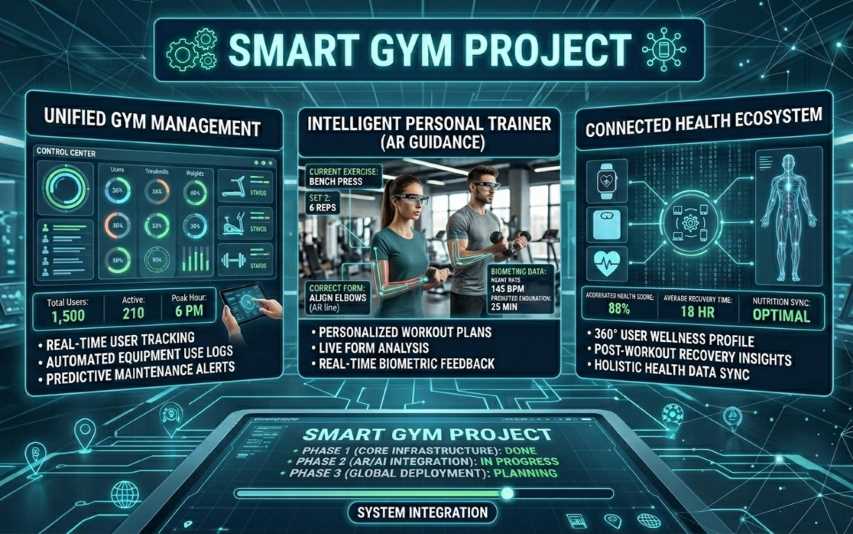
🤔 What is a Smart Gym Project?
A Smart Gym Project represents the integration of advanced digital technologies—such as the Internet of Things (IoT), Artificial Intelligence (AI), cloud computing, and data analytics—into fitness facilities to create an intelligent, personalized, and highly efficient workout environment.
Unlike traditional gyms where members manually log workouts, guess their weights, and rely on generic advice, a smart gym transforms every piece of equipment, every movement, and every heartbeat into actionable data. Machines recognize you when you tap in, adjust settings automatically, track your reps and form in real time, and sync everything seamlessly to your mobile app.
The ultimate goal of a smart gym project is to deliver hyper‑personalized fitness experiences that maximize member results, improve retention, reduce operational costs, and generate new revenue streams for facility owners. According to industry projections, the global smart fitness market is expected to surge from $33.47 billion in 2025 to $106.52 billion by 2030, growing at a compound annual growth rate of 26.1%.
✨ Why Build a Smart Gym? The Core Benefits
The shift from traditional to smart gyms delivers measurable advantages for both members and operators.
💪 Personalized Training at Scale
Members no longer need to guess what to do. AI-powered systems like EGYM Genius analyze millions of workout data points to generate automated, personalized training plans tailored to each individual’s experience level, goals, and the specific equipment available in the gym. Echelon’s WorkoutBuilder and StrengthIQ use proprietary AI to assess a member’s effort and range of motion, then automatically adjust the next session in real time.
📈 Enhanced Member Retention and Engagement
Data‑driven engagement strategies significantly reduce churn. Clubs using data‑powered models see up to 30% more new members and 20% higher retention. Anytime Fitness’s SmartCoaching technology uses predictive analytics to craft personalized health plans and even identifies members at risk of canceling, allowing staff to provide timely support and interventions.
🏃 Operational Efficiency and Cost Savings
Smart gyms reduce staffing costs while improving service quality. AI‑powered smart screens provide guided workouts, video tutorials, and technique correction without requiring a personal trainer for every member. Unmanned gyms operating 24/7 use IoT technology to interconnect all equipment, enabling real‑time data uploads and automated building systems that adjust lighting and air conditioning based on foot traffic.
🔧 Real‑Time Form Correction and Safety
Computer vision systems act as virtual coaches, using pose estimation to track repetitions, analyze form, and log workout data automatically. This not only improves results but also prevents injury. A Cornell University study showed that users training with an intelligent squat coaching system made significantly greater improvements in technique than those without feedback. In staffless facilities, advanced AI monitors the environment for anomalies—detecting sudden falls or aggressive behavior—and instantly triggers alerts to local authorities.
🔌 Seamless Equipment Integration
One of the biggest frustrations in traditional gyms is equipment that doesn’t communicate. Smart gyms solve this with solutions like Virtuagym Connect, a simple device that attaches to existing stack‑weight strength machines, instantly capturing sets, reps, and weight in real time and syncing data straight to the gym’s app. Similarly, Echelon’s FitHub sensors track every lift on any machine, applying AI‑powered programming without requiring any changes to the gym floor.
🛠️ Core Components of a Smart Gym Project
A successful smart gym project integrates several essential technologies working in harmony.
📡 IoT‑Enabled Smart Equipment
Every piece of equipment becomes a data collection point. HUR’s SmartTouch technology transforms each machine into an intelligent, interconnected computerized exercise system. When a user taps an RFID bracelet or card, the machine automatically adjusts seat position, lever arm length, and resistance according to the user’s individual program. Performance data—sets, reps, resistance, power, range of motion—is stored and reported automatically.
🤖 AI and Machine Learning Platforms
AI serves as the cognitive engine of the smart gym. EGYM Genius uses data from over 340 million assessment data points to generate recommendations for individualized training plans that evolve with each completed session. Echelon’s AI not only analyzes a member’s effort but also their range of motion to determine if the weight and reps are appropriate, then automatically adjusts the next workout. The system even prescribes recovery each week.
🔐 Biometric Access and Identification
Gone are the days of keycards and QR codes. Edge AI uses facial recognition to grant access, ensuring only active members enter while preventing tailgating and unauthorized use. RFID wristbands enable automatic user identification, activating personalized training programs with a single touch.
📱 Integrated Mobile Apps and Wearables
The member experience extends far beyond the gym floor. Mywellness from Technogym is an open platform that allows operators to manage each customer’s experience based on personal needs and passions, ensuring the best results in the shortest time. TrueFits uses AI to analyze user body type, health goals, and workout history, delivering a customized workout plan directly to the user’s phone.
🖥️ Smart Screens and Virtual Coaching
Kinetic provides AI‑powered smart screen technology that delivers guided group or individual workouts, enhanced by video tutorials, movement and effort tracking, technique correction, and leaderboard rankings. These screens use cameras to gamify workouts, offering shout‑outs when users reach goals or complete training rounds, helping maintain motivation.
🔌 Equipment‑Agnostic Integration Layers
A truly smart gym doesn’t require replacing all existing equipment. Solutions like Virtuagym Connect attach directly to existing stack‑weight strength machines, instantly turning them into smart equipment without a full hardware overhaul. Echelon’s platform is equipment‑agnostic, designed to integrate with whatever a facility already has—from legacy weight stacks to the newest connected machines.
🏗️ Types of Smart Gym Models
Smart gyms come in several distinct flavors, each suited to different markets and business models.
🏢 Traditional Gyms with Smart Upgrades
These are conventional fitness clubs that have integrated smart technologies into their existing operations. They may use EGYM’s ecosystem of software and connected equipment, or implement Virtuagym Connect to digitize their strength floor. Members receive automated training plans, progress tracking, and seamless app integration while still enjoying staff support and group classes.
🌙 Unmanned / 24/7 Smart Gyms
These facilities operate without on‑site staff, leveraging IoT and AI to manage everything from access control to safety monitoring. Unmanned gyms provide flexible, personalized fitness solutions available 24/7, addressing the fragmented fitness needs of modern urban populations. Edge AI acts as the intelligent gatekeeper for access, the virtual coach for performance tracking, and the invisible guardian for safety.
🏠 Smart Home Gyms
Designed for residential use, these compact systems bring the smart gym experience directly into living rooms. Tonal, for example, is a wall‑mounted device just over 4 feet tall and less than 2 feet wide that uses electromagnetic weights to simulate up to 200 pounds of resistance. It features AI technology that stores customized weight goals for individual exercises and automatically adjusts weight for every workout. Other home smart gyms include The Mirror, which streams live and on‑demand fitness classes through a mirror‑like interface, and the compact digital cable resistance machine Speediance Gym Nano.
🏨 Hybrid / White‑Label Platforms
Some smart gym projects focus on software rather than hardware. Echelon has evolved from a connected equipment manufacturer into an AI‑powered SaaS platform that provides ecosystems for gyms to establish new revenue streams, whether or not they carry Echelon equipment. The Elevate app streams a gym’s live and on‑demand content to members, while FitPass provides additional workouts, mindfulness, and recovery content.
🌍 Real‑World Smart Gym Projects
| Project / Initiative | Organization | Key Focus | Impact / Status |
|---|---|---|---|
| EGYM Genius | EGYM | AI‑based software creating automated personalized training plans across all equipment types | Uses 340M+ assessment data points; tailors plans to individual, club, and available equipment |
| Echelon AI Platform | Echelon | Equipment‑agnostic SaaS with WorkoutBuilder and StrengthIQ for personalized programming | Integrates FitHub sensors to track any lift; AI adjusts workouts based on effort and range of motion |
| Anytime Fitness SmartCoaching | Anytime Fitness | Predictive analytics for personalized coaching and retention | SmartEngagement predicts cancellations; coaches manage 60 clients instead of 40‑45 |
| HUR SmartTouch | HUR | RFID‑enabled smart strength equipment with automatic adjustments | Seat, resistance, and program auto‑load; stores all performance data for reporting |
| Tonal | Tonal (Home gym) | Electromagnetic weight system with AI coaching | 200 lbs digital weight; auto‑adjusts for each exercise; tracks reps, volume, and metrics |
| Virtuagym Connect | Virtuagym | Device that turns existing strength machines into smart equipment | Captures sets, reps, weight in real time; syncs directly to app without manual logging |
| Kinetic AI | Kinetic | AI‑powered smart screen for guided workouts in gyms | Video tutorials, technique correction, leaderboards; gamifies workouts to boost motivation |
| Unmanned Smart Gyms | Various (e.g., Liking Fit, Lefit) | 24/7 facilities with IoT and AI for access, tracking, and safety | Smart air conditioning/lighting adjusts automatically; equipment uploads real‑time exercise data |
🧐 Challenges and Considerations for Implementation
Building a smart gym project is a complex undertaking. Here are the key challenges to address.
🔒 Data Privacy and Security
Smart gyms collect highly sensitive biometric and health data. Unauthorized access can result in privacy breaches or potential misuse. As one commentator noted: “Smart gyms could be laboratories for the future of preventative care … But that future requires rules as sophisticated as the sensors: limits on how long data is kept, guardrails on how it is shared, and transparency about who profits from every rep you record”. Operators must ensure rigorous compliance with data protection regulations and implement robust security protocols.
🔗 Integration with Legacy Equipment
Most gyms already have significant investments in traditional strength equipment. The challenge is turning analog machines into smart devices without a rip‑and‑replace approach. Solutions like Virtuagym Connect and Echelon’s FitHub sensors address this by attaching to existing equipment, but not all legacy machines may be compatible.
⚖️ Cost and Return on Investment
The upfront costs of smart equipment, software licenses, sensors, and staff training can be substantial. However, operators report significant returns: Anytime Fitness franchisees saw 21% of revenue stem from personal training powered by their app, and coaches increased their client capacity from 40‑45 to 60 members without compromising quality.
🧠 User Adoption and Change Management
Members accustomed to traditional workouts may be hesitant to embrace technology. Smart gyms must balance high‑tech features with a welcoming, intuitive experience. HUR addresses this with touchscreen interfaces displaying animated workout instructions and progress visuals. Anytime Fitness emphasizes that technology enhances, rather than replaces, human interaction, noting that “lasting change comes from modifying behaviors, supported by genuine human interactions”.
⚠️ Reliability and Uptime
In unmanned smart gyms, reliability is critical. If the AI node controlling access freezes at 2 AM, members are locked out. If a tracking screen freezes mid‑workout, the premium experience vanishes. Operators need robust remote management solutions—like Allxon’s Out‑of‑Band Management—that allow hardware‑level reboots without dispatching technicians.
🔮 The Future of Smart Gyms
The smart gym is rapidly evolving. Here are the key trends shaping its future.
🗣️ Conversational AI Coaches
At CES 2026, Merach unveiled an intelligent treadmill featuring the industry’s first large language model‑powered conversational AI coach. The system doesn’t just display data; it adjusts speed and incline in real‑time based on heart rate and speaks with users like a human trainer.
🔄 Proactive, Anticipatory AI
Future AI systems will anticipate needs rather than simply responding to commands. By analyzing movement patterns, fatigue indicators, and recovery status, AI will dynamically adjust training programs. When the system detects fatigue, it will proactively suggest lower intensity; when you’re performing well, it will encourage you to push further. Future systems will integrate training and recovery seamlessly, with AI monitoring fatigue and automatically recommending rest periods, stretching routines, or recovery modalities based on individual needs.
📱 Deeper Wearable Integration
New wearables like smartwatches, rings, and AI‑driven sensors can track more than just heart rate. HRV (heart rate variability) trends, sleep insights, and readiness scores will increasingly inform personalized programming. Platforms like Zwift are creating massive social worlds where users can cycle or run with others in role‑playing games.
🏛️ AI‑Powered Retention and Revenue Optimization
Predictive analytics will become increasingly sophisticated. SmartEngagement features can already identify members at risk of canceling based on workout frequency and progress. Future systems will automate personalized re‑engagement campaigns, special offers, and even coach interventions, turning data into direct revenue protection.
🏠 The Blurring Line Between Home and Gym
By 2027, smart equipment that connects to apps, tracks progress, and provides personalized feedback will be standard, not exceptional. Members expect equipment that works equally well in home and commercial settings, with designs that maximize space efficiency without sacrificing functionality.
🏁 A Smart Gym Project is far more than a technology upgrade—it is a fundamental reimagining of how fitness is delivered and experienced. By weaving together IoT sensors, AI coaching, biometric access, and integrated mobile platforms, smart gyms create an environment where every rep is tracked, every workout is personalized, and every member feels supported.
The journey is not without its challenges—data privacy, integration costs, and reliability remain significant hurdles. However, the real‑world examples showcased here demonstrate that these challenges are surmountable. From EGYM’s AI‑powered training plans powering millions of workouts to Echelon’s equipment‑agnostic platform upgrading legacy gym floors, the benefits are real and measurable.
For any fitness operator looking to the future, the smart gym is not just an option—it is becoming the standard. It represents a commitment to putting members at the center of a seamlessly connected, intelligently supported, and continuously improving fitness ecosystem. The future of fitness is smart, data‑driven, and—most importantly—personalized to every individual who walks through the door.
 |  |  |
 |  |  |