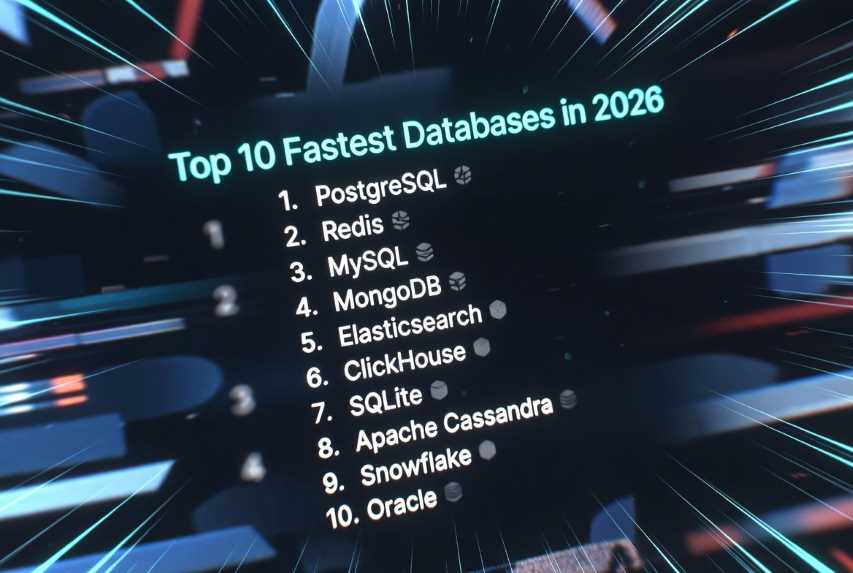
In 2026, databases must deliver exceptional speed (low latency and high throughput) while powering real-world applications at massive scale. The explosion of AI (especially vector search and RAG), real-time analytics, IoT, high-traffic web/mobile apps, and data-intensive workloads has made performance and proven adoption more important than ever.
This guide presents a curated top 10 that balances two key factors:
Widespread adoption — drawn from the DB-Engines Ranking (June 2026), industry surveys, job demand, and real-world deployments.
Speed & performance — backed by benchmarks (sysbench, TPC-H, real-world throughput) and architectural strengths (in-memory, columnar, advanced indexing, vector support).
These databases dominate modern stacks and continue to evolve with multi-model capabilities, vector search, and cloud-native features.
Quick Comparison Table
Rank | Database | Primary Type | DB-Engines Rank (Jun 2026) | Standout Speed Strength | Best For in 2026 |
|---|---|---|---|---|---|
1 | PostgreSQL | Relational + multi-model | 4 | Complex queries, JSONB, vector search, concurrency | Modern apps, AI, hybrid workloads |
2 | Redis | Key-Value + multi-model | 8 | Sub-millisecond in-memory operations | Caching, real-time features, sessions |
3 | MySQL | Relational | 2 | High-throughput simple OLTP & reads | Web apps, e-commerce, CMS |
4 | MongoDB | Document | 5 | Flexible schema + horizontal scaling | Content platforms, mobile backends |
5 | Elasticsearch | Search + Vector | 12 | Near real-time search & aggregations | Search, logging, recommendations, observability |
6 | ClickHouse | Columnar OLAP | Rising fast | Extreme analytics speed on massive datasets | Real-time BI, metrics, ad tech |
7 | SQLite | Embedded Relational | 11 | Zero-overhead local file I/O | Mobile, desktop, edge, embedded systems |
8 | Apache Cassandra | Wide-Column | 10 | Massive write throughput & linear scalability | IoT, time-series, high-scale event data |
9 | Snowflake | Cloud Data Warehouse | 6 | Elastic compute + fast petabyte queries | Analytics, data science, cloud BI |
10 | Oracle Database | Relational + multi-model | 1 | Mission-critical tuned OLTP/OLAP performance | Enterprise finance, ERP, large-scale systems |
Data based on DB-Engines Ranking (June 2026) and performance characteristics from benchmarks and production use.
PostgreSQL – The Versatile Performance Leader
PostgreSQL ranks #4 in popularity (score ~688) and showed the strongest growth in the first half of 2026. It excels as a reliable, standards-compliant, open-source database with outstanding multi-model capabilities.
Performance strengths: Outstanding results on complex queries, JOINs, and analytics. JSONB is significantly faster than MySQL’s JSON implementation in many benchmarks. The pgvector extension delivers fast vector similarity search for AI applications. Strong concurrency handling and continuous improvements in recent versions (vacuum efficiency, query planning).
Why it ranks high: One database often replaces multiple specialized tools. Huge ecosystem (PostGIS, TimescaleDB, Citus for distribution). Trusted by Instagram, Spotify, Reddit, and thousands of startups and enterprises.
Best for: Full-stack applications, AI-enhanced systems (vector + relational), geospatial services, and teams wanting strong consistency with modern features.
Pros: Free, extremely feature-rich, ACID-compliant, excellent community and cloud options (Supabase, Neon). Cons: Steeper learning curve for advanced tuning; can be resource-intensive for very simple workloads.
Redis – The Real-Time Speed Champion
Redis (and its popular open-source fork Valkey) remains the go-to in-memory data store, ranking solidly in the top 10.
Performance strengths: Sub-millisecond latency and millions of operations per second on modest hardware. Supports rich data structures (strings, lists, sets, sorted sets, hashes, streams, geospatial). Excellent for caching, which dramatically reduces load on primary databases.
Why it ranks high: Almost every high-scale application uses Redis or Valkey as a caching, session, queue, leaderboard, or real-time feature layer. It is the de facto speed layer in modern architectures.
Best for: Caching, real-time leaderboards, chat/messaging, rate limiting, session management, and pub/sub.
Pros: Extremely fast, simple to use, versatile data structures, strong persistence options. Cons: Primarily in-memory (RAM cost at extreme scale); eventual consistency in some clustered setups.
MySQL – The Web-Scale Workhorse
MySQL holds the #2 spot in DB-Engines rankings and powers a huge portion of the web.
Performance strengths: Excellent read performance and solid write throughput for straightforward OLTP workloads. Highly optimized for web use cases with mature replication and clustering options (including MySQL Group Replication and cloud services like Aurora).
Why it ranks high: Ubiquitous in shared hosting, WordPress, e-commerce platforms, and content management systems. Easy to administer and widely supported.
Best for: Web applications, e-commerce sites, content platforms, and any read-heavy transactional workload.
Pros: Mature, fast for common web patterns, huge ecosystem, easy to scale horizontally in the cloud. Cons: Weaker on complex analytical queries and JSON performance compared to PostgreSQL.
MongoDB – Flexible Document Speed
MongoDB ranks #5 and remains the leading document-oriented database.
Performance strengths: Fast document reads/writes with flexible schemas. Excellent horizontal scaling via sharding. Strong performance for write-heavy or evolving data models. Good built-in support for geospatial and time-series data.
Why it ranks high: Dominant choice for modern web and mobile backends where schema flexibility matters. Powers many content platforms, catalogs, and user-generated data systems.
Best for: Content management, product catalogs, mobile backends, real-time personalization, and applications with rapidly changing data structures.
Pros: Developer-friendly JSON-like documents, horizontal scaling, rich query language. Cons: Eventual consistency in distributed setups; can consume more storage than relational alternatives.
Elasticsearch – Search and Observability Speed
Elasticsearch (and OpenSearch) excels in search and analytics workloads despite a lower overall ranking.
Performance strengths: Near real-time full-text search, aggregations, and vector similarity search. Extremely fast at indexing and querying large volumes of log, event, or document data.
Why it ranks high: Core of the ELK/EFK stack for logging and observability. Widely used for site search, recommendation engines, and security analytics.
Best for: Full-text search, log aggregation, application performance monitoring, recommendation systems, and AI-powered semantic search.
Pros: Blazing search performance, powerful aggregations, strong ecosystem. Cons: Resource-heavy at scale; eventual consistency model.
ClickHouse – Analytics Speed Demon
ClickHouse has rapidly gained traction for real-time analytical workloads.
Performance strengths: Columnar storage with exceptional compression and query speed on massive datasets (often orders of magnitude faster than traditional row-based databases for aggregations). Sub-second queries on billions of rows are common.
Why it ranks high (rising fast): Ideal for observability, metrics, logs, ad tech, and real-time dashboards. Used by companies like Uber and Cloudflare.
Best for: Real-time analytics, business intelligence, monitoring, and any workload needing fast aggregations on large volumes of data.
Pros: Extremely fast and efficient on analytical queries, open source, great compression. Cons: Less suited for high-concurrency transactional workloads; steeper learning curve for SQL users accustomed to row stores.
SQLite – The Most Ubiquitous Embedded Database
SQLite may not top enterprise rankings, but it is arguably the most widely deployed database on the planet.
Performance strengths: Blazing fast for local operations because there is no network or server process overhead. Direct file I/O with full ACID compliance. Extremely low latency for embedded use cases.
Why it ranks high: Powers Android and iOS apps, web browsers, desktop applications (VS Code, etc.), IoT devices, and edge computing. Billions of deployments worldwide.
Best for: Mobile and desktop applications, embedded systems, edge/IoT devices, testing, and any scenario needing a zero-config relational database.
Pros: Zero configuration, tiny footprint, rock-solid reliability, completely free. Cons: Not designed for high-concurrency server workloads (single writer limitation in classic mode).
Apache Cassandra – Massive Scale Write Performance
Cassandra (and its high-performance C++ implementation ScyllaDB) is built for extreme scale.
Performance strengths: Linear scalability and very high write throughput with tunable consistency. Excellent availability and fault tolerance across data centers.
Why it ranks high: Powers some of the largest distributed systems (Netflix, Apple, etc.) for time-series, messaging, and IoT data.
Best for: High-volume write workloads, time-series data, IoT/sensor data, and globally distributed applications needing high availability.
Pros: Massive scale, high write performance, no single point of failure. Cons: Eventual consistency by default; complex data modeling for queries.
Snowflake – Cloud Analytics at Scale
Snowflake has become a leader in cloud data warehousing.
Performance strengths: Separation of storage and compute enables instant elasticity. Very fast ad-hoc queries on petabyte-scale data with excellent concurrency for BI and data science workloads.
Why it ranks high: Dominant in modern data teams for analytics, data sharing, and AI data pipelines.
Best for: Cloud analytics, data warehousing, data science, and collaborative data platforms.
Pros: Excellent performance and elasticity, strong security and governance, pay-per-use model. Cons: Can become expensive at very high usage; proprietary (though with strong ecosystem).
Oracle Database – Enterprise Performance Powerhouse
Oracle remains #1 in the DB-Engines Ranking thanks to its dominance in large enterprises.
Performance strengths: Highly optimized for mission-critical transactional and analytical workloads. Advanced features like Real Application Clusters (RAC), in-memory options, and sophisticated query optimization deliver top-tier performance when properly tuned.
Why it ranks high: The backbone of banking, telecommunications, government, and large ERP systems worldwide.
Best for: Large-scale enterprise OLTP, financial systems, ERP/CRM, and any environment requiring maximum reliability, security, and performance with strict compliance needs.
Pros: Mature, extremely robust, rich feature set, strong support. Cons: Expensive licensing; complex administration.
Key Trends Shaping Databases in 2026
Multi-model & Vector Support — Most top databases now offer or integrate vector search for AI applications.
Real-time everything — Demand for sub-second analytics and features drive adoption of ClickHouse, Redis, and Elasticsearch.
Cloud-native & Serverless — Elastic scaling (Snowflake, Aurora, Neon, PlanetScale) reduces operational burden.
Hybrid architectures — Common pattern: PostgreSQL or MongoDB as primary store + Redis for speed + Elasticsearch/ClickHouse for search and analytics.
Open-source forks & alternatives — Valkey (Redis), rising interest in ScyllaDB, and strong growth for PostgreSQL and ClickHouse.
How to Choose the Right Database in 2026
Start with your primary workload:
Transactional web/apps with flexibility needs → PostgreSQL or MongoDB
Extreme low latency / caching / real-time → Redis (or Valkey)
Simple high-volume web → MySQL
Search, logs, recommendations → Elasticsearch
Real-time analytics on big data → ClickHouse
Embedded / mobile / edge → SQLite
Massive distributed writes → Cassandra / ScyllaDB
Cloud analytics & data sharing → Snowflake
Mission-critical enterprise → Oracle or Microsoft SQL Server
Many organizations use polyglot persistence — combining 2–4 of these databases for optimal results.
The database world in 2026 rewards architectures that prioritize both raw speed and developer productivity while scaling reliably. PostgreSQL’s continued rise shows that versatility and performance can coexist beautifully.
 |  |  |
 |  |  |