Behind the Scenes Technology of the Avatar Movies
James Cameron’s Avatar franchise represents one of the most audacious and transformative technological achievements in the entire history of filmmaking. From the groundbreaking original Avatar released in 2009, through the visually staggering Avatar: The Way of Water in 2022, to the epic Avatar: Fire and Ash in 2025, the series has consistently pushed the boundaries of what cinema can achieve.
Cameron, collaborating intimately with his team at Lightstorm Entertainment and the world-class artists and engineers at Wētā Effects, did far more than simply adopt cutting-edge tools—he actively invented, refined, and reimagined entire pipelines of technology. The goal was always crystal clear: to preserve the raw, unfiltered emotional authenticity of human actors’ performances while transporting audiences into the breathtaking, immersive alien ecosystem of Pandora. This detailed exploration dives deep into the revolutionary technologies behind each film, revealing the intricate engineering, relentless innovation, and artistic vision that made these movies not just blockbusters, but landmarks in cinematic history.
Avatar (2009): Laying the Foundation with Performance Capture and Real-Time Virtual Production
When Avatar hit theaters in 2009, computer-generated imagery was already impressive, yet it often felt detached from genuine human emotion. Cameron’s team solved this by championing performance capture, a technique they elevated from traditional motion capture into something far more nuanced and actor-centric.
The Nuance of Performance: Unlike basic motion capture, which primarily tracks body movements using marker suits and then applies them to digital characters, performance capture records the complete essence of an actor’s delivery—including the tiniest facial twitches, eye darts, lip quivers, vocal inflections, and emotional timing—all in real time.
Actor Integration: This approach ensured that the Na’vi characters felt alive and deeply relatable, carrying the subtle humanity of performers like Zoe Saldaña as Neytiri, Sam Worthington as Jake Sully, and Sigourney Weaver as Doctor Grace Augustine.
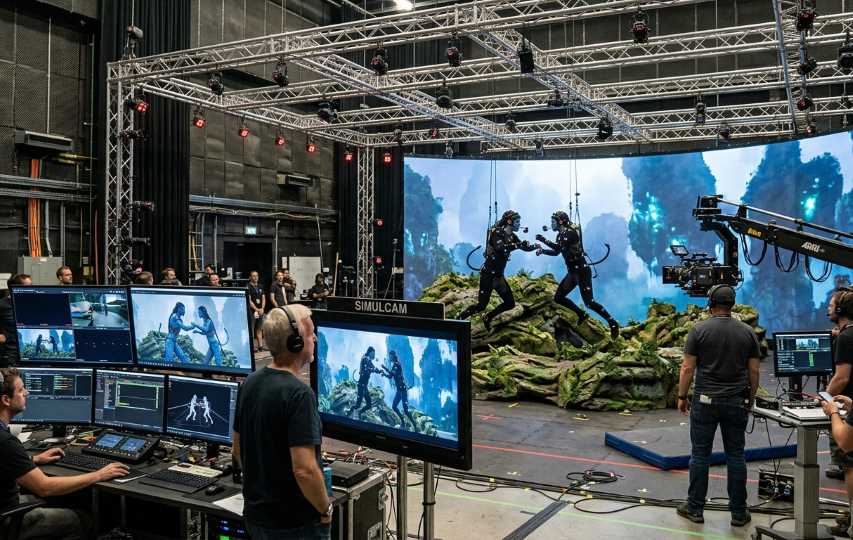
The Technical Rig: Actors entered a massive capture volume wearing form-fitting suits dotted with thousands of reflective markers. Lightweight head rigs, equipped with miniature high-resolution cameras positioned inches from their faces, recorded every micro-movement. These rigs fed data into the sophisticated Facial Action Coding System at Wētā Effects, which meticulously translated muscle contractions and skin deformations into hyper-realistic digital Na’vi faces.
Digital Models: Multiple custom computer-generated character models were created for each actor, allowing precise control over everything from skin texture and pore detail to the way light interacted with their alien features.
The Virtual Camera and Fusion Systems
At the heart of the production was the SimulCam, a revolutionary virtual camera system co-developed by Cameron’s longtime collaborator Glenn Derry. This hybrid device merged live-action camera feeds with real-time motion-capture data, projecting low-resolution versions of the computer-generated imagery characters and environments directly onto monitors.
Cameron could literally walk through a virtual Pandora, framing shots, adjusting actor positions, and directing scenes as if they were unfolding on a physical set. Powered by software like Autodesk MotionBuilder, the SimulCam turned the empty studio volume—surrounded by over a hundred infrared cameras—into a fully interactive digital playground.
Complementing this was Cameron’s custom Fusion Camera System, developed in partnership with stereo expert Vince Pace. This stereoscopic three-dimensional rig captured native three-dimensional footage for both live-action elements and virtual scenes, delivering an unparalleled sense of depth and immersion. Behind the scenes, the visual effects pipeline was enormous: individual shots often involved dozens of layered renders, with some frames taking over 100 hours to compute on vast render farms.
Avatar: The Way of Water (2022): Mastering Underwater Performance Capture and Hyper-Realistic Water Simulation
For the sequel, Cameron raised the stakes dramatically by making photorealistic underwater sequences the film’s emotional and visual core. It took a full 18 months of dedicated research and development to overcome what many experts initially deemed impossible.
The Underwater Performance Capture Revolution
The team constructed an enormous custom tank measuring 42 feet by 85 feet by 32 feet deep at Manhattan Beach Studios in Los Angeles.
The Environment: This state-of-the-art facility featured powerful turbines to generate realistic currents, programmable wave machines, bottom surge systems, and a massive movable platform that could simulate beaches, reefs, and modular underwater sets.
The Training: Actors underwent intensive training with free-diving specialist Kirk Krack, learning to hold their breath for several minutes while executing complex emotional scenes.
The Breakthrough: Traditional infrared motion-capture systems failed underwater due to light refraction. Engineers developed a groundbreaking dual-volume setup. Infrared cameras operated above the waterline, while specialized ultraviolet cameras below the surface used non-visible spectrum lighting that provided crystal-clear tracking data.
Advanced Rigs: A new generation of stereo head rigs, combined with advanced neural-network software, enhanced facial capture even further—accurately simulating delicate eye fibers and the subtle ways water distorted expressions.
Breakthroughs in Water Visual Effects
Wētā Effects developed the proprietary Loki water-simulation framework, a massive leap forward in fluid dynamics. It incorporated advanced solvers for every conceivable water behavior: procedural ocean waves, turbulent bulk water, fine spray and mist, intricate bubble systems, foam generation, and realistic wetness effects on characters.
The film contained over 2,225 individual water-effect shots. Challenges were immense: bubble systems had to differentiate between large, hero turbulent bubbles and thousands of tiny diffuse ones using complex incompressible Navier-Stokes equations combined with Fluid-Implicit Particle and Affine Particle-In-Cell methods. The entire production demanded 18.5 petabytes of data and millions of central processing unit hours across global render farms.
Avatar: Fire and Ash (2025): Refining Emotional Depth with Hybrid Filmmaking
By the time Avatar: Fire and Ash entered production, the technology had evolved into a mature, highly refined pipeline that placed actor-driven storytelling front and center.
Cinematography Workflow: Key advancements included a flexible post-capture cinematography workflow. After performances were recorded, editors and Cameron could later choose intimate close-ups or sweeping wide shots directly in the virtual space.
Physicality: Production embraced greater hybrid filmmaking techniques. Practical stunts, real-world sets, and physical props were integrated more extensively. Flying rigs for ikran sequences and even Cirque du Soleil performers for dynamic Tulkun water ballets were captured on stage before being enhanced with visual effects.
Elements: Wētā Effects tackled the film’s most ambitious scope yet: massive volcanic eruptions, realistic fire and ash simulations, and complex character deformations under extreme heat involving lava flows and smoke plumes.
The Broader Pipeline and Lasting Legacy
Across all three films, a meticulously orchestrated end-to-end pipeline tied everything together. Pre-visualization teams created detailed digital storyboards, while massive render farms handled the computational load, optimizing everything from global illumination to subsurface scattering on Na’vi skin.
The Avatar series did not merely create spectacular visuals—it fundamentally redefined performance capture as a respected art form that celebrates rather than supplants actors. These films demonstrate that the most powerful technology is the kind that remains invisible to the audience, serving only to deepen emotional connection. As the Avatar saga continues, the technological foundation established in these films promises even more astonishing leaps forward, while remaining entirely in service of unforgettable human and Na’vi stories.
 |  |  |
 |  |  |