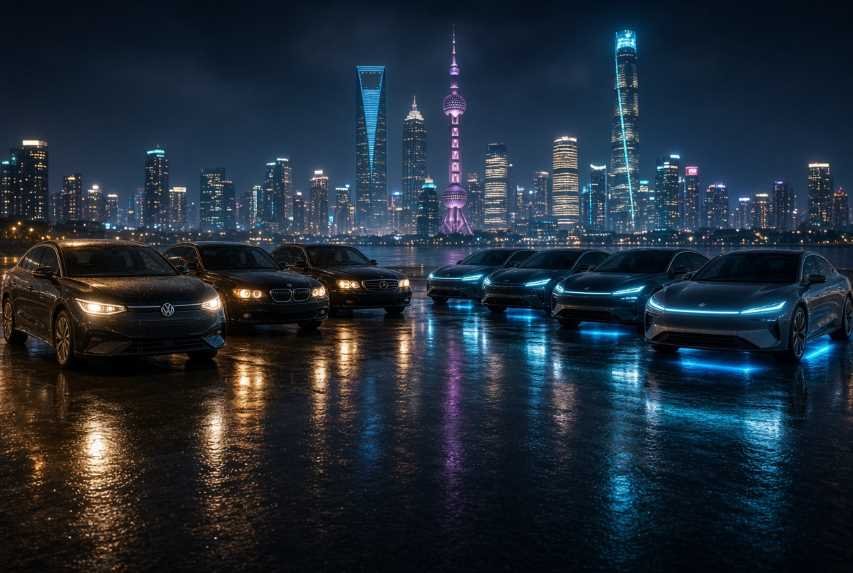
For more than two decades, China was the prize that made Germany’s automotive model work. Volkswagen, BMW, Mercedes-Benz, Audi and Porsche sold millions of cars there, booked outsized profits from joint ventures, and treated the world’s largest car market as proof that German engineering still set the global standard. That era is ending.
China is no longer a market that rewards imported prestige and combustion-engine craftsmanship. It has become the laboratory of the electric, software-defined car. New energy vehicles — battery-electric cars and plug-in hybrids — already account for more than half of passenger-car retail sales, and in some recent months more than three in five. Chinese manufacturers such as BYD, Geely, SAIC, NIO, XPeng, Li Auto and Xiaomi now compete on batteries, software, price and speed of product development. German brands, once symbols of quality and status, are increasingly described by younger Chinese buyers as cars for their parents.
The central question is no longer whether German manufacturers face pressure in China. They do. The question is whether they are losing the automotive battle there — and what that means for the future of the global car industry.
Germany's Historic Automotive Dominance
Germany’s car industry was built on mechanical excellence. From the early days of Karl Benz and Gottlieb Daimler through the postwar Wirtschaftswunder, German firms defined what a well-engineered automobile should feel like: precise engines, refined transmissions, rigid bodies, and a culture of manufacturing quality that became a national brand.
Volkswagen grew into the world’s second-largest automaker by volume. BMW and Mercedes-Benz turned driving dynamics and luxury into global status. Audi and Porsche extended that reputation into performance and design. For much of the late twentieth century, German cars were the benchmark against which others were measured.
China became essential because it combined scale with aspiration. As the middle class expanded, buyers wanted vehicles that signaled success. German brands offered exactly that. Starting in the 1980s, Volkswagen entered through joint ventures — most importantly FAW-Volkswagen and SAIC Volkswagen — and built a manufacturing empire that at its peak delivered more than four million vehicles a year in China. BMW and Mercedes followed with their own local production. China was not a side market. For years it accounted for a large share of group volumes and, at Volkswagen, a disproportionate share of profits that helped sustain high wages and investment in Germany.
Those brands became more than products. They were social currency. A Mercedes E-Class or BMW 5 Series in a Chinese city said something about the owner. That prestige is not gone. It is no longer sufficient.
Why China Became Critical to German Automakers
China is still the world’s largest automotive market. In 2025, passenger-car retail sales were around 23.7 million units, roughly 30 percent of the global market. Even after a sharp slowdown in 2026 — first-half passenger-car retail sales fell more than 20 percent year on year to about 8.7 million units — the country remains too large for any volume manufacturer to ignore.
German dependence ran deeper than headline sales. Joint ventures gave access to factories, dealers and political relationships. Local production avoided some import barriers and allowed long-wheelbase versions tailored to Chinese tastes. Premium demand was especially valuable because margins were higher than in Europe’s crowded mass market.
That dependence is now a vulnerability. According to S&P Global Mobility data cited by Reuters, German brands’ combined China sales fell by about a quarter over five years to 3.9 million vehicles in 2025. Their market share dropped from about 26 percent in 2019 to about 16 percent in 2025. The Center of Automotive Management in Germany has put the 2025 figure at 15.4 percent. Non-Chinese brands as a group saw their share of the Chinese market slide from 57 percent in 2020 to 32 percent in 2025.
Losing China does not merely mean fewer cars sold in one country. It means weaker profits, less money for research, and a smaller industrial base at home. It also means German firms must fight Chinese rivals in Europe, Latin America, Southeast Asia and Africa — markets where those rivals are already expanding.
The Rise of China's Automotive Industry
Chinese automakers were once dismissed as low-cost assemblers of outdated technology. That description is obsolete.
Industrial policy mattered. Beijing treated new energy vehicles as a strategic industry, using subsidies, purchase-tax exemptions, license-plate privileges in congested cities, and support for battery and materials supply chains. Domestic competition was ferocious. Dozens of firms fought for share, which forced rapid product cycles and aggressive pricing.
Scale followed. China became the world’s largest EV market and the largest battery producer. CATL and BYD dominate global battery installations. In the first half of 2026, CATL held about 39.9 percent of the global EV battery market and BYD about 14.4 percent; seven Chinese firms among the top ten accounted for more than 70 percent of global installations. That supply-chain depth is difficult for latecomers to replicate.
Software and electronics became as important as metal. Chinese firms invested in in-house operating systems, large screens, voice assistants, over-the-air updates and driver-assistance suites. Many developed vehicles as digital products first and mechanical objects second. Development cycles of roughly 18 to 24 months became common, compared with longer Western programs built around global platforms and multi-year validation.
The result was not a single national champion but an ecosystem: battery specialists, software companies, electronics firms, and automakers that could combine those pieces quickly.
The Electric Vehicle Revolution
The shift from internal-combustion engines to electric power changed the competitive map.
German advantages — engines, gearboxes, chassis tuning, and a century of brand meaning attached to those skills — matter less when the “engine” is a battery pack and software. EVs still require excellent engineering. They also require cheap, high-performing batteries, fast charging, dense charging networks, and digital features that buyers use every day.
China built those pieces earlier and at larger scale. Battery costs fell as production expanded. Vertical integration, especially at BYD, reduced dependence on outside suppliers. Charging infrastructure grew to more than 23 million points by the end of July 2026, according to Chinese official figures. Consumer adoption followed: new energy vehicles reached about 54 percent of passenger-car retail sales in 2025 and around 65 percent in July 2026, with battery-electric cars alone near 44 percent that month.
The transition weakened Germany’s traditional edge in two ways. First, it compressed the value of combustion know-how. Second, it rewarded companies that could iterate software and electronics as fast as smartphone makers. German firms were organized around long product cycles, supplier hierarchies, and hardware excellence. China’s EV industry was organized around speed.
BYD and the New Chinese Challenge
BYD is the clearest illustration of the new challenge.
The company began as a battery maker, not a heritage car brand. That origin is now an advantage. BYD designs and produces its own batteries, including blade-style lithium iron phosphate cells, and has integrated motors, electronics and vehicle assembly. Vertical integration gives it cost control that most traditional manufacturers, which buy batteries from specialists, find hard to match.
BYD’s product range stretches from inexpensive city cars to premium and performance sub-brands. Pricing is aggressive in China and still competitive abroad after shipping and tariffs. In 2025 the company sold on the order of 4.6 million vehicles globally, including about 2.26 million battery-electric cars — more than Tesla’s 1.64 million deliveries that year. China still accounted for the majority of those volumes, but overseas sales crossed one million units in 2025, and management later raised the 2026 export target toward 1.5 million.
The comparison with the German model is structural. A traditional German group designs a global platform, sources batteries, manages a complex supplier network, and sells on brand, driving feel and residual value. BYD treats the car as a battery-and-electronics product that can be updated and priced to win share. In China, that model overtook Volkswagen as the top-selling manufacturer in 2024. Geely then pushed Volkswagen into third place in 2025.
BYD is not invulnerable. Its China sales fell sharply in the first half of 2026 — domestic volumes dropped on the order of 40 percent as the price war and weaker demand hit the mass market — and profits compressed. The company’s response has been to export more, because margins outside China are often higher. That is precisely why German manufacturers now face BYD not only in Shenzhen but in Berlin, São Paulo and Bangkok.
Why German Automakers Are Struggling
The German struggle in China is not a simple story of complacency. It is a mix of structure, timing and market change.
EV development was slower. Many early German electrics were adapted from combustion platforms. Dedicated architectures arrived later. In a market that now treats plug-in vehicles as the default new-car choice, that delay was costly. In the first quarter of 2026, Volkswagen, Audi, BMW, Mercedes-Benz and Porsche together took only about 1.6 percent of China’s battery-electric registrations — 19,200 cars out of roughly 1.2 million — a 55 percent year-on-year drop after purchase-tax support was reduced. Volkswagen’s own EV sales in China fell more than 70 percent in that quarter.
Costs are higher. German production, even when localized, carries the overhead of global engineering organizations, premium labor systems and complex quality processes. Chinese volume makers can price more aggressively because their cost base is lower and their product cycles shorter.
Software has been a recurring weakness. Infotainment that feels dated next to a Chinese rival, slower over-the-air updates, and driver-assistance systems that lag local leaders have all been cited by analysts and by company executives themselves. Organizational complexity — multiple brands, joint ventures, and decision chains that run through Wolfsburg, Munich or Stuttgart — makes it harder to match a 18-month Chinese refresh cycle.
Consumer preferences shifted toward large screens, AI voice control, high-speed charging and frequent software updates. Brand loyalty, once a German asset, weakened among younger buyers. Price pressure then amplified every other weakness. Premium badges still sell, but they no longer command the same price gap.
None of this means German companies lack engineering talent. It means their historical advantages are less decisive in the product category that now dominates China.
Software Is Becoming as Important as the Engine
The modern car is becoming a software-defined vehicle: a rolling computer whose features can be improved after sale.
Chinese manufacturers leaned into that idea. Operating systems, app stores, smartphone-like home screens, cloud services and AI assistants are central to how cars are marketed. Over-the-air updates fix bugs and add functions. Driver-assistance suites — sometimes developed with technology firms such as Huawei — are sold as everyday conveniences, not optional extras.
German manufacturers have invested heavily in the same areas, including new electrical architectures and partnerships. Progress is real. It has often been slower to reach Chinese showrooms in a form that local buyers prefer. A German cockpit can still be beautifully built and a German chassis superbly tuned. If the screen, voice assistant and assistance features feel a generation behind, many Chinese customers will choose the more digital car.
This is not only a technology gap. It is a cultural one. Chinese consumers live inside smartphone ecosystems. They expect the car to behave like another connected device. German companies historically sold driving machines that happened to have electronics. The market now often wants the reverse.
The Smartphone Effect
Xiaomi made the point impossible to ignore.
A company known for phones, consumer electronics and internet services entered the car business and, within two years, became a serious EV player. In 2025 Xiaomi EV delivered more than 410,000 vehicles. Its SU7 sedan outsold Tesla’s Model 3 in China that year. The later YU7 SUV extended the lineup. Cumulative deliveries passed 760,000 by mid-August 2026.
Xiaomi did not invent the automobile. It brought a consumer-electronics logic: industrial design, software integration, ecosystem lock-in, aggressive pricing for the specification, and a brand already sitting in millions of pockets. That logic is spreading. If a car is a battery, a computer and a set of services, then a phone company is not an outsider. It is a plausible competitor.
The implication is larger than one brand. The definition of an automaker is widening. Heritage still matters in some segments. It no longer guarantees control of the mass-premium electric market.
Chinese Consumers Are Changing
Younger Chinese buyers did not grow up associating German brands with the only acceptable form of modernity. They grew up with domestic internet platforms, domestic phones and, increasingly, domestic cars that look expensive inside and update like software.
Expectations now include large displays, dense connectivity, competitive driving-assistance features, fast charging and frequent updates. Price-to-feature ratio matters more than a foreign badge. Domestic brands have also gained prestige. Owning a well-specified Chinese EV is no longer a compromise in many urban circles; it can be a statement of being current.
Volkswagen’s China brand chief, Robert Cisek, captured the social shift when he told Reuters that some younger customers now see Volkswagen as “the brand for the parents.” That sentence explains more than a sales chart. Prestige has a half-life. When the product category changes, inherited status decays.
Germany's Industrial and Economic Problems
The China problem collides with a harder German industrial backdrop.
Energy costs in Europe rose after the shock of the early 2020s and remain a structural issue for energy-intensive manufacturing. Labor costs in German plants are high by global standards. Environmental and safety regulation is strict, which raises compliance costs even when the goals are widely supported. The combustion-engine transition requires enormous capital at the same moment that China profits and volumes are falling.
Volkswagen has discussed one of the industry’s largest restructurings: previously agreed German job reductions, plus reports in 2026 of plans that could raise total cuts toward 100,000 roles worldwide and put several German plants at risk. Those plans face union resistance and remain subject to negotiation; they are not a completed fact. They do show how seriously management views the cost gap. BMW has flagged large restructuring charges. Mercedes has tightened spending.
These pressures are facts of industrial economics, not moral judgments. They help explain why German firms cannot simply “do what BYD does” inside Germany. The cost structure, labor system and regulatory environment are different.
Volkswagen: A Special Case
Volkswagen is the special case because China was its second home.
In 2019 the group sold about 4.2 million cars in China, around 40 percent of global deliveries. In 2025 China sales were about 2.7 million, down roughly a third from that peak, and new-energy deliveries there fell 44 percent to about 115,500 units. In the first half of 2026 deliveries fell another 26 percent to 971,000 — the lowest first-half total since 2010. The second quarter alone was down 36.6 percent.
Volkswagen was China’s best-selling automaker for a quarter century. BYD took the crown in 2024. Geely pushed Volkswagen to third in 2025. The group still has strength in combustion cars, and in some early-2026 windows fuel-car share even looked resilient as EV incentives faded. That is a shrinking pond. With plug-in vehicles taking most of the market, winning yesterday’s segment does not restore yesterday’s leadership.
The company has responded with an “in China, for China” strategy: local development centers, partnerships including work with XPeng, a wave of new energy models, and claims of large cost reductions on locally developed EVs. Those steps are rational. Whether they are fast enough is the open question. Several analysts have argued that a near-term rebound in China sales is unlikely. Regain of mass-market leadership looks harder still. A more realistic goal is to stop the slide, rebuild relevance among younger buyers, and protect a profitable niche rather than the old number-one position.
BMW, Mercedes-Benz, Audi and Porsche
The premium brands are not identical, and they are not failing in the same way.
BMW has often been the most resilient of the German premium trio in China, but resilience is relative. Group China sales were about 626,000 in 2025, down 12.5 percent. The brand’s fully electric share in China has been only around 5 percent in a market where EVs are approaching half or more of sales. Second-quarter 2026 China deliveries fell about 30 percent. The company’s answer is the Neue Klasse architecture, with long-wheelbase electric models aimed at China from late 2026. The bet is that a dedicated EV platform, long range and better digital features can recapture premium buyers. The risk is timing: Chinese rivals have not paused while BMW prepared the new generation.
Mercedes-Benz Mercedes has been hit harder. China sales fell about 19 percent in 2025 and then dropped around 27 percent in the first quarter of 2026 and about 30 percent in the second. The brand is increasing local production, launching China-specific models and bringing MMA-platform electrics such as a locally built electric GLC. It still has brand power at the top of the market. It has struggled to convert that power into electric volume against digitally flashy domestic rivals. A localized, cheaper electric CLA sold only a little more than a thousand units in China in the first half of 2026, while Xiaomi’s SU7 sold tens of thousands in a similar price neighborhood — a brutal illustration of changed taste.
Audi was the best-selling single luxury brand in China in 2025 with about 617,000 vehicles, a milder 5.6 percent decline than its peers. That relative strength still masks EV weakness and growing pressure in the mid-luxury sedan segment, where prices of the A6L and rivals have been cut. Audi has launched a China-only AUDI electric brand with SAIC and is bringing PPE-platform models, in some cases with local intelligent-driving partners. The dual-brand approach is an admission that the classic four-ring identity is no longer enough on its own.
Porsche is a small-volume, high-margin specialist, and China has been painful. China deliveries fell 26 percent in 2025 to about 41,900 vehicles. Global deliveries dropped 10 percent to 279,449, the worst annual decline since 2009. The company has delayed some electric launches, leaned back toward combustion models that still sell, and shrunk its dealer network. “Quality over quantity” may protect the brand. It does not restore the China volumes that once padded group profits.
Chinese EVs Are Not Simply “Cheap Cars”
The old Western reflex — that Chinese cars win only because they are cheap — is outdated.
Leading Chinese models now compete on range, charging speed, interior technology, driver assistance, design and perceived quality, while still undercutting German prices for a given specification. Battery integration, 800-volt architectures, large displays and frequent software updates are no longer exotic. Manufacturing quality at the top Chinese firms has improved enough that many buyers no longer treat “Made in China” as a penalty inside China.
Price still matters. The dangerous combination for German manufacturers is price plus features plus speed. A cheap car can be dismissed. A cheaper car that also feels more modern is a direct assault on the German value proposition.
The Price War
China’s EV market has been in a grinding price war. Discounts deepened in 2025 and 2026 as too many models chased slowing demand. BYD’s average price cuts accelerated at points to around 10 percent. Rivals followed. Even the market leader saw domestic sales and profits fall.
German brands have been forced to cut prices on staple models such as the BMW 5 Series, Mercedes E-Class and Audi A6L, with transaction prices sliding from the old 400,000-yuan-plus comfort zone toward lower bands. Premium branding still supports a gap. It does not create immunity.
Price wars destroy profits for everyone, including Chinese firms. They are especially damaging for high-cost producers. Every discount on a German car in China is a reminder that brand equity is being spent to defend volume.
European Protection and Chinese EV Tariffs
Europe has not watched this shift passively. In 2024 the European Union imposed anti-subsidy duties on battery-electric cars made in China, on top of the standard 10 percent car tariff. Final additional rates have been in the region of 17 percent for BYD, about 19 percent for Geely, 20.7 percent for many cooperating firms, 7.8 percent for Tesla’s Shanghai-built cars, and more than 35 percent for non-cooperating exporters.
Supporters argue that Chinese industrial policy created an unfair cost advantage and that without duties Europe would import unemployment. Critics — including German carmakers themselves when the duties were voted — warn that tariffs invite retaliation, raise prices for European consumers, and do not make European factories more competitive. Germany voted against the measures, reflecting its exposure in China.
The policy is already evolving at the edges. Volkswagen’s Anhui joint venture secured a path to replace duties on certain China-built Cupra EVs with a quota and minimum-price arrangement. Chinese exporters are studying similar deals. Meanwhile Chinese brands have still gained share in Europe, reaching around 10 percent of the market in 2026 by some industry estimates, with forecasts of further growth by 2030.
Protection can buy time. It cannot reverse a technology and cost gap by itself.
Are Chinese Automakers Now Technologically Ahead?
Leadership is not universal. It is category-specific.
Category | German automakers | Leading Chinese automakers EV product breadth in China | Late and still thin in volume terms | Broad lineups refreshed quickly Batteries | Strong partnerships, limited cell-making scale | CATL and BYD dominate global installations Software and user experience | Improving, historically hardware-first | Designed around screens, OTA and apps AI features and voice assistants | Available, often less central to the pitch | Core selling point for many models Autonomous / advanced assistance | Capable systems, slower localization | Fast iteration with local tech partners Manufacturing speed | Longer global cycles | Shorter local cycles Cost efficiency | High in Europe, improving in China | Structural advantage in volume EVs Charging technology | Competitive at the premium end | Scale advantage plus dense public networks Vehicle connectivity | Strong in principle | More native to local digital ecosystems Premium branding | Still a clear German lead | Rising, not yet equal at the very top Global expansion | Deep dealer and service networks | Fast export growth from a smaller base
German firms still lead in many aspects of chassis refinement, long-distance brand trust, motorsport-derived performance engineering and, in some markets, residual values. Chinese firms lead in the battery-software-cost triangle that now decides mass-market EV success in China. Declaring one side “ahead” in every dimension is propaganda. Declaring that the decisive dimensions have shifted toward China is analysis.
Why Germany Cannot Simply Copy China
Copying a BYD or a Xiaomi is not a software download.
German companies operate under different labor law, energy prices, environmental rules and corporate governance, including powerful works councils. They carry decades of investment in combustion platforms and factories designed around engines. Their software organizations were built as suppliers to a hardware company, not as the center of the product. Their customers in Europe still buy differently from customers in Shenzhen.
They can localize in China, partner with Chinese tech firms, and design China-only models. Many are doing exactly that. They cannot transplant China’s industrial policy, battery cluster or consumer software culture into Lower Saxony.
China's Global Expansion
The contest is no longer confined to China.
Chinese manufacturers have pushed into Europe, Southeast Asia, Latin America, the Middle East, Africa and Australia. BYD’s overseas sales exceeded one million units in 2025 and were running at a much higher rate in 2026. In Europe, BYD has already outsold Tesla in some national EV markets in individual periods. Chinese brands as a group have taken a notable share of European registrations and have overtaken Japanese makers in some monthly comparisons.
Exports matter more as China’s home market slows and price-war margins shrink. A car that earns a thin profit in China can earn a thicker one abroad. That logic will keep Chinese metal flowing into markets where Volkswagen, Toyota and others long assumed they understood the rules.
Over the next decade, the global industry could look less like a German-Japanese-American oligopoly with China as a factory floor, and more like a Chinese-led EV supply system competing with Western premium specialists and a few global volume survivors.
What Germany Is Doing to Fight Back
The response is underway.
New dedicated EV platforms are arriving: Volkswagen’s local China models, BMW’s Neue Klasse, Mercedes’s MMA and forthcoming MB.EA products, Audi and Porsche’s PPE architecture. Software strategies are being rebuilt, sometimes with Chinese partners. Battery strategies include European cell projects and contracts with CATL and others. Factories are being modernized. Costs are being cut, painfully.
Localization is the most important tactical shift. Cars developed in Hefei or Shenyang for Chinese tastes, at Chinese cost, with Chinese software partners, have a better chance than imported concepts. Volkswagen has said locally developed EVs can be produced far more cheaply than earlier efforts.
Are the measures sufficient? They are necessary. Sufficiency depends on speed. In a market that can launch hundreds of new models in a few months, a three-year platform program is a long time. The next product cycle will tell more than another strategy presentation.
Three Possible Futures
Scenario 1 — Germany makes a comeback German firms execute localized EV programs, close the software gap, accept lower margins, and recapture a durable share of China’s premium and upper-volume segments. Europe uses a mix of industrial policy and genuine cost reduction to hold the home market. China remains huge but not decisive enough to break the German industrial model. This scenario requires near-flawless execution and some relief from China’s price war.
Scenario 2 — China dominates the EV era Chinese manufacturers keep winning on cost, batteries and software. German share in China continues to erode. Chinese brands take a double-digit and then larger share of Europe and emerging markets. German employment and factory utilization fall structurally. Premium niches survive, but the volume heart of the industry migrates. Elements of this scenario are already visible.
Scenario 3 — A new balance German brands remain strong in true luxury, performance and certain combustion or hybrid holdouts where regulation allows. Chinese companies dominate mass-market EVs and much of the technology stack. The industry splits into a German-European premium pole and a Chinese volume-and-electronics pole, with collaboration and tariffs both part of the landscape. This may be the most plausible medium-term outcome.
Global Economic Consequences
Cars are not just consumer goods in Germany. They are a pillar of exports, skilled employment, supplier networks and regional prosperity. A lasting loss of China profits plus incoming Chinese competition in Europe threatens that pillar. Reported restructuring debates at Volkswagen — including possible six-figure job cuts over time — show how large the adjustment could be, even if final numbers are negotiated down.
For China, automotive success is industrial policy made visible: batteries, materials, electronics, and a global export machine. For supply chains, battery production is already concentrated in Chinese firms. For trade politics, cars have become a front line of EU-China tension. For geopolitics, control of EV technology sits next to control of energy transition hardware.
The automobile industry matters beyond showrooms because it sits at the intersection of manufacturing, software, minerals and national power.
What This Means for the Future of Cars
The deeper story is a change in what a car is.
For a century the automobile was a machine built around an engine. The best companies were those that mastered combustion, metal and the culture of driving. The car of the coming decade is a software-, battery-, AI- and data-driven platform that happens to have wheels. Range, charging, updates, assistance features and ecosystem lock-in will decide more purchases than the sound of an engine.
German industry helped invent the first version of the automobile. Chinese industry is helping invent the second. The firms that accept that shift — in product, organization and cost — will still matter. The firms that treat it as a temporary fashion will not.
Final Verdict
Is Germany losing the car battle in China?
In the market that now matters most inside China — electric and software-rich vehicles — yes. German brands have already lost overall market leadership, lost most of the EV segment, and lost a generation of younger buyers who no longer treat a German badge as automatic proof of modernity. Combined German share has fallen from roughly a quarter of the market at the end of the 2010s to the mid-teens. In battery-electric registrations, the famous five are a rounding error.
Germany has not lost everything. It still has premium brands with global meaning, deep engineering cultures, large installed bases, and the capacity to build excellent vehicles. Combustion-car strength in China is real, if shrinking. In some export markets the dealer networks and service reputation remain advantages Chinese newcomers must still earn.
China’s advantage is concentrated where the industry is going: batteries, cost, software speed and EV product breadth. That advantage can be contested in niches. It is unlikely to be reversed in the mass market by brand heritage alone.
Reversal, if it happens, will require German manufacturers to think less like exporters of European cars and more like local technology companies in China — while simultaneously cutting costs at home without destroying the skills they still need. The next five to ten years will decide whether they remain global industrial powers or become high-end specialists in a Chinese-shaped EV world.
The battle in China is not a verdict on German history. It is a test of whether that history can be rewritten in time.
FAQ
Is Germany really losing the car battle in China? In electric vehicles and among younger buyers, German brands have lost far more ground than the overall market decline can explain. They remain present and still sell millions of cars, but they no longer set the pace.
Why did Volkswagen lose first place in China? Volkswagen was slow to field competitive EVs while BYD and then Geely rode the new-energy wave. Young buyers also began to see the brand as dated. Combustion strength could not offset weakness in the growing half of the market.
Are Chinese EVs lower quality than German cars? The gap has narrowed sharply at leading firms. Many Chinese EVs now compete on features and perceived quality, not only price. German cars can still feel more refined in some driving respects; that is no longer the whole purchase decision.
Why are batteries so important? The battery is the most expensive EV component and a large part of range, charging speed and cost. China, through CATL, BYD and others, dominates global cell production. That is a structural advantage.
Will EU tariffs stop Chinese cars in Europe? Tariffs raise prices and slow some imports. They have not stopped Chinese brands from gaining European share, and they create retaliation risk. They buy time; they do not replace competitiveness.
Can BMW, Mercedes and Audi hold the premium segment? They can hold part of it, especially at the top. In the broad premium-electric space they already face Li Auto, NIO, Xiaomi and others. Price cuts on core sedans show the segment is no longer a fortress.
Is BYD a threat only in China? No. BYD’s overseas sales have surged as the home market became less profitable. Europe, Latin America and other regions are now part of the same contest.
What must German manufacturers change first? Faster local product cycles in China, software that matches local expectations, and a cost base that can survive a price war. Brand storytelling will not substitute for those three.
Does this mean the German auto industry is finished? No. It means the industry’s old formula — sell premium combustion excellence into a rising China — is finished. A smaller, more electric, more software-driven German industry can still prosper. It will not look like the industry of 2015.
What should readers watch over the next two years? Whether Neue Klasse, localized Volkswagen EVs and Mercedes’s new electric architectures sell in China in meaningful numbers — and whether Chinese brands’ European share keeps rising after tariffs. Those two indicators will show if the battle is stabilizing or still running one way.
 |  |  |
 |  |  |