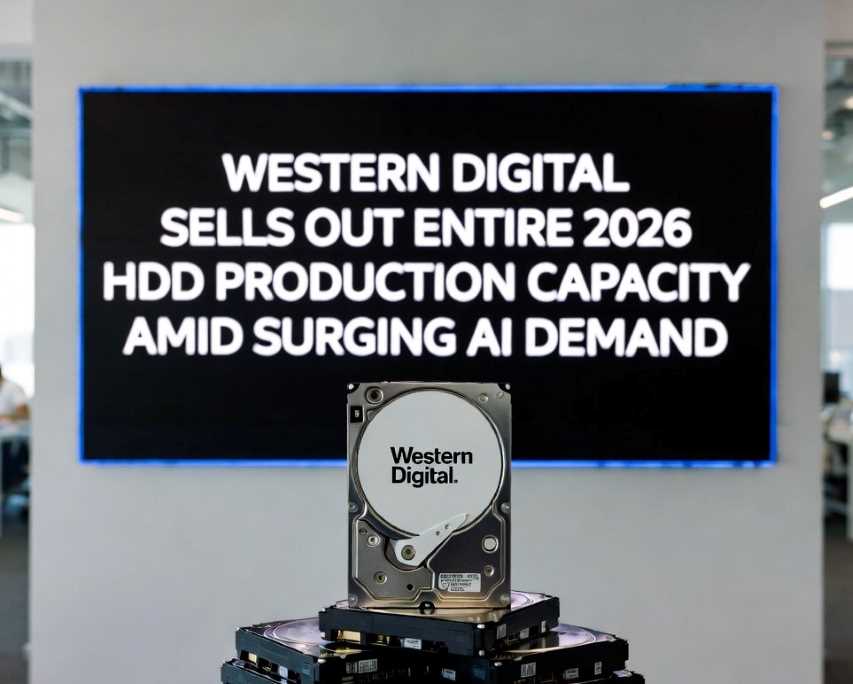
In a stunning revelation that underscores the explosive growth of Artificial Intelligence and the ever-expanding needs of data centers worldwide, Western Digital Corporation has announced that its entire Hard Disk Drive production capacity for the calendar year 2026 is already fully sold out. This announcement, made by Chief Executive Officer Irving Tan during the company's second-quarter earnings call for 2026, highlights the unprecedented demand coming from hyperscale cloud providers, Artificial Intelligence-driven enterprises, and large-scale data storage operations. As a result, consumers, small businesses, and even some mid-tier buyers might face significant shortages, potential delays in product availability, and inevitable price increases throughout the year and possibly beyond. This development not only reflects the rapid evolution of the technology industry but also signals a broader shift where enterprise-level demands are prioritizing over traditional consumer markets, reshaping how storage solutions are allocated and priced.
The Announcement and Key Details
Western Digital, a global leader in data storage technologies with a history spanning decades, confirmed this complete sell-out just a few weeks into the new year. During the earnings call, Chief Executive Officer Irving Tan explicitly stated, "As we highlighted, we’re pretty much sold out for calendar 2026." He went on to explain that the company has successfully secured firm Purchase Orders from its top seven customers, which means every single unit rolling off the production lines this year has already been committed to these major buyers. Adding to this, Western Digital has established Long-Term Agreements with two of these key clients that extend well into 2027, and one agreement that stretches even further to 2028, providing the company with remarkable stability and predictability in its revenue stream.
This strategic move comes at a time when the storage market is undergoing a profound transformation. Enterprise and cloud segments now dominate Western Digital's overall revenue, accounting for an impressive 89% of the company's income, while the consumer products division has shrunk to a mere 5%. The surge in demand is primarily driven by the massive data requirements of Artificial Intelligence applications, where enormous datasets are needed for training sophisticated machine learning models, real-time data processing, and long-term archiving. Hard Disk Drives, with their high capacity and cost-effectiveness for bulk storage, remain a preferred choice over Solid-State Drives for these purposes, despite Solid-State Drives offering faster access speeds. Tan also noted that the company's focus on high-margin enterprise deals has allowed it to optimize production without immediate expansions, ensuring efficiency and profitability.
Driving Forces Behind the Sell-Out
The root cause of this production capacity crunch can be traced back to the ongoing Artificial Intelligence boom, which has created an insatiable hunger for storage solutions across the tech ecosystem. Artificial Intelligence companies, cloud service providers, and data centers are acquiring storage hardware at an unprecedented pace, far outstripping the needs of traditional consumer segments. Western Digital's Hard Disk Drives are especially valued in this context because they provide economical, high-density storage ideal for petabyte-scale operations, such as storing vast amounts of unstructured data like videos, images, and sensor inputs used in Artificial Intelligence training.
This situation is not unique to Western Digital; industry peers like Seagate Technology have reported similar constraints, with their own 2026 production quotas being nearly or entirely committed to large clients. Broader market trends are exacerbating this, including shortages in related components such as Dynamic Random-Access Memory, NAND Flash chips, and even Graphics Processing Units, all of which are critical for Artificial Intelligence infrastructure. Analysts attribute this to a combination of factors: the post-pandemic recovery in global supply chains, geopolitical tensions affecting manufacturing hubs, and the exponential growth in data generation fueled by advancements in generative Artificial Intelligence, edge computing, and the Internet of Things.
Furthermore, the shift toward hyperscale data centers—operated by giants like Amazon Web Services, Microsoft Azure, and Google Cloud—has intensified competition for storage resources. These facilities require reliable, scalable storage to handle the deluge of data from Artificial Intelligence workloads, including natural language processing, computer vision, and predictive analytics. As a direct outcome, Western Digital's stock performance has been stellar, with shares rising 63.4% year-to-date, as investors recognize the value in the company's secured long-term contracts and its pivotal role in supporting the Artificial Intelligence revolution.
Implications for Consumers and the Market
For everyday users, this announcement could translate into real challenges, particularly for those who depend on Hard Disk Drives for personal or small-scale applications such as Network-Attached Storage systems, home media servers, desktop backups, or expansive gaming libraries. With the bulk of production earmarked for enterprise clients, retail channels may experience severe shortages, leading to extended backorders that could push delivery times into late 2026 or even 2027. Prices for consumer-grade Hard Disk Drives are already climbing, mirroring trends seen in other hardware categories like Random-Access Memory and Solid-State Drives, where costs have in some instances quadrupled due to persistent supply chain bottlenecks.
Owners of Network-Attached Storage devices, which often rely on multiple high-capacity Hard Disk Drives for redundant storage arrays, should be especially vigilant. As Western Digital increasingly prioritizes lucrative enterprise contracts, there may be less emphasis on innovating or expanding consumer-focused product lines, potentially resulting in fewer options or slower updates for features like vibration resistance, power efficiency, or compatibility with home networking standards. Experts in the field suggest that consumers explore alternative strategies to mitigate these risks, such as opting for Solid-State Drives in smaller capacities where speed is more critical, investing in hybrid storage setups that combine Hard Disk Drives with Solid-State Drive caching, or even considering cloud-based storage services as a supplement, though these come with ongoing subscription costs and privacy considerations.
On the brighter side for Western Digital, this sell-out scenario offers exceptional visibility into future demand and bolsters its competitive edge in the Artificial Intelligence-dominated market. By focusing on high-value clients, the company can achieve better margins and invest in research and development for next-generation technologies, such as Heat-Assisted Magnetic Recording or Energy-Assisted Perpendicular Magnetic Recording, which promise even higher storage densities. However, this pivot raises questions about market equity, as smaller players and individual consumers might be sidelined in favor of big tech conglomerates.
Looking Ahead
As Artificial Intelligence continues to redefine the technological landscape, Western Digital's bold announcement serves as a clear indicator of where the storage industry is headed in the coming years. With long-term deals locked in through 2028, the company appears poised for sustained growth, financial stability, and innovation in enterprise storage solutions. Yet, this comes with potential trade-offs for the broader market, including higher costs and limited access for non-enterprise users. Industry observers will undoubtedly monitor evolving pricing trends, supply chain adaptations, and any announcements regarding production expansions or new manufacturing facilities.
In the meantime, for those in need of Hard Disk Drives—whether for professional setups or personal use—it's advisable to act swiftly and secure supplies from current inventories, as the 2026 production is effectively history. This event not only highlights the transformative power of Artificial Intelligence but also prompts a reevaluation of how global supply chains can better balance the needs of diverse stakeholders in an increasingly data-centric world. Stay informed on the latest developments in tech and storage innovations for more insights into navigating these changes.
 |  |  |
 |  |  |