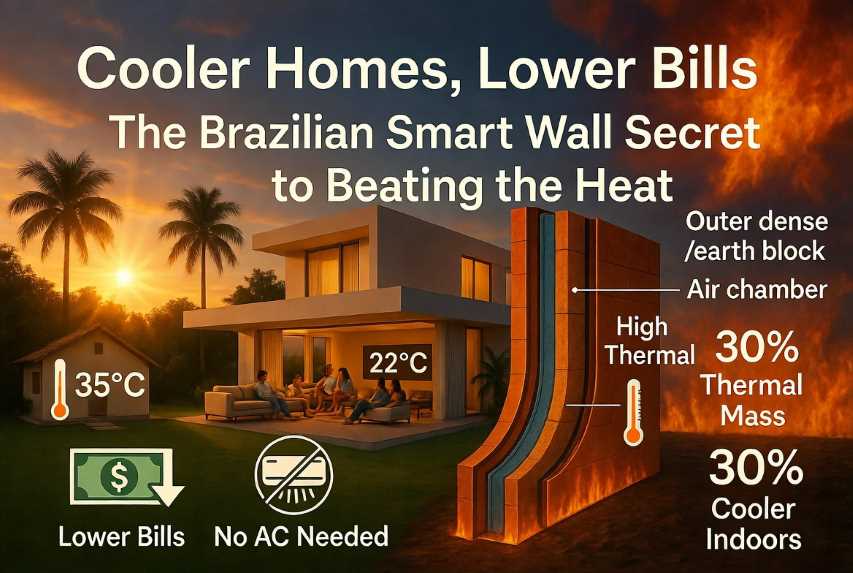
As Brazil faces increasingly severe heatwaves fueled by climate change, a groundbreaking yet elegantly simple architectural innovation is quietly revolutionizing how homes, schools, and public buildings maintain comfortable indoor temperatures across the country’s most challenging climates. These “smart walls” — carefully engineered with thicker profiles, high-density materials, and time-tested thermal principles — are achieving dramatic reductions in internal heat buildup of up to 30 percent, all without the need for power-intensive air conditioning systems.
This passive cooling breakthrough is particularly timely in a nation where record-breaking temperatures have become the new normal. From the scorching semi-arid Northeast to the humid urban centers of the Southeast and the dense tropical zones of the North, families and businesses have long struggled with interiors that turn into stifling ovens long after sunset. Traditional thin-walled construction, common in modern developments, allows heat to rush indoors rapidly, driving up energy consumption and discomfort. In contrast, Brazil’s smart wall technology draws on both ancient indigenous building knowledge and cutting-edge engineering to create structures that naturally regulate temperature, slash electricity bills, and significantly lower carbon emissions.
The approach is gaining rapid momentum among architects, engineers, and policymakers who see it as a scalable, affordable solution for a warming planet. By prioritizing thermal inertia and strategic design, these walls transform buildings into self-regulating thermal havens, offering a model that could influence construction practices not only across Latin America but around the globe.
Understanding the Science: How Smart Walls Harness Thermal Inertia for Natural Cooling
At the core of this innovation lies the powerful concept of thermal inertia — essentially the capacity of dense building materials to absorb, store, and gradually release heat over extended periods. In simple terms, imagine a thick stone wall as a massive thermal battery. During the intense midday sun, the wall soaks up solar energy like a sponge, preventing it from flooding straight into living spaces. Hours later, when outdoor temperatures finally begin to drop in the evening, the stored heat is released slowly, keeping interiors warmer in cooler nights or, more importantly in Brazil’s context, moderating extreme daytime spikes.
Unlike lightweight modern walls that heat up and transfer warmth indoors almost immediately, smart walls delay this process dramatically. The result is a far more stable indoor climate throughout the full 24-hour cycle, with temperature swings reduced by as much as 30 percent compared to conventional designs. This delay in heat transfer is what makes the difference between a sweltering living room at 3:00 post meridiem and a pleasantly cool one that stays comfortable well into the night.
Engineers enhance this effect through double-wall systems featuring an internal air chamber. The outer layer absorbs the brunt of solar radiation, while the air gap between the two walls functions as a natural insulator, further slowing heat movement. The inner wall then acts as a final barrier, ensuring minimal warmth reaches occupants. Experts describe this layered approach as creating a “thermal lag” that can shift peak indoor heat by six to eight hours or more, perfectly aligning cooler indoor conditions with the times when people are most active indoors.
Complementing these structural elements is a resurgence in the use of traditional materials such as adobe and stabilized earth blocks. These environmentally friendly options possess exceptionally high thermal mass, meaning they excel at both absorbing heat during the day and moderating humidity levels in Brazil’s often muggy environments. Unlike synthetic insulation that can trap moisture and degrade over time, earthen materials naturally breathe, helping regulate indoor air quality while maintaining thermal stability. Modern versions incorporate stabilizers for improved durability and seismic resistance, making them suitable even for urban high-rises or earthquake-prone regions without sacrificing their cooling prowess.
Beyond the Walls: Roofs, Ventilation, and Shading Complete the Passive Cooling System
Smart walls achieve their impressive results most effectively when integrated into a holistic building strategy. Roofs, for instance, play a critical supporting role. By increasing roof mass, adding reflective coatings, or incorporating ventilated designs, heat gain from above can be reduced by an additional 8 to 10 degrees Celsius in some cases. This prevents the entire structure from acting as a heat collector, allowing the walls to focus on managing side solar exposure.
Strategic cross-ventilation further amplifies the benefits. Buildings designed with openings on opposite sides create natural airflow corridors that draw in cooler evening breezes while expelling accumulated hot air. When combined with well-placed shading devices — such as extended eaves, overhanging balconies, or traditional brise-soleils — direct sunlight is blocked before it even reaches the walls. These elements work in harmony to minimize initial heat absorption, making the entire passive system exponentially more efficient.
In Brazil’s diverse microclimates, these complementary strategies are tailored locally. In the Northeast’s dry heat, emphasis might be placed on maximum thermal mass and minimal windows facing west. In the humid Amazon basin, enhanced ventilation and moisture-regulating materials take priority. This region-specific customization ensures optimal performance without compromising architectural beauty or cultural identity.
Tangible Benefits: Comfort, Savings, and Environmental Impact Across Brazil
The real-world advantages of smart walls extend far beyond mere temperature control. Homeowners in pilot projects report not only cooler interiors during peak summer months but also substantial reductions in monthly electricity costs — sometimes by 40 percent or more — as reliance on fans and air conditioners drops sharply. This is especially meaningful in low-income communities where energy bills can consume a disproportionate share of household income.
On a broader scale, widespread adoption could ease strain on Brazil’s national power grid, which often faces peak-demand pressures during heatwaves. Lower energy consumption also translates directly into reduced greenhouse gas emissions, aligning perfectly with the country’s ambitious climate commitments. When local materials like adobe are sourced regionally, the environmental footprint shrinks even further due to decreased transportation needs and lower embodied carbon compared to imported insulation products.
Health benefits are equally compelling. More stable indoor temperatures and humidity levels help prevent heat-related illnesses, improve sleep quality, and reduce respiratory issues linked to poor air circulation in overly sealed, air-conditioned spaces. Schools and hospitals equipped with these systems have noted higher productivity among students and better recovery rates for patients — outcomes that carry profound social value.
From Ancient Wisdom to Modern Innovation: A Cultural and Technological Renaissance
What makes Brazil’s smart wall movement particularly inspiring is its deep roots in indigenous and traditional building practices. For centuries, native communities across the continent constructed thick earthen walls that provided natural refuge from extreme weather. Today’s architects are reviving and refining these methods with contemporary tools, including computer simulations that optimize wall thickness, orientation, and material composition for specific sites.
Government initiatives and green building certifications are accelerating adoption, encouraging developers to incorporate thermal performance standards into new residential and commercial projects. As Brazil prepares to host major international climate forums, these innovations position the nation as a leader in resilient, low-energy construction — proving that cutting-edge sustainability can be achieved through intelligent design rather than expensive technology.
Challenges remain, of course. Retrofitting existing buildings requires careful planning, and initial material costs can be slightly higher than standard thin walls. Yet the long-term savings, durability, and comfort more than compensate, with payback periods often measured in just a few years.
Looking Ahead: A Cooler, Greener Future for Brazilian Living
As global temperatures continue their upward trend, Brazil’s embrace of smart walls offers a beacon of hope and practicality. These structures demonstrate that effective climate adaptation need not rely on energy-guzzling gadgets or complex machinery. Instead, thoughtful architecture that works with nature — rather than against it — can deliver profound results.
The movement is already inspiring similar approaches in neighboring countries facing comparable heat challenges. For Brazil itself, expanding smart wall implementation could become a cornerstone of national housing policy, urban planning, and rural development alike.
In the end, this is more than just a construction trend; it represents a thoughtful return to balanced living in harmony with the environment. By investing in smarter walls today, Brazil is building not only cooler homes but a more sustainable legacy for generations to come.
 |  |  |
 |  |  |