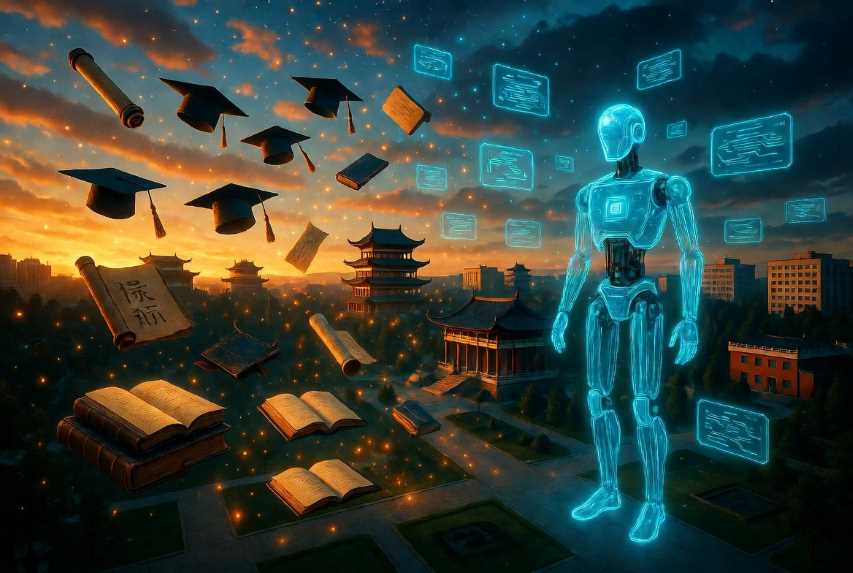
Between 2021 and 2025, Chinese higher education institutions revoked or suspended over 12,200 undergraduate programs while introducing more than 10,200 new ones. This unprecedented restructuring touched more than 30 percent of all degree offerings nationwide, marking one of the most significant realignments of university education in modern history. The central driver: preparing millions of young people for an economy where artificial intelligence is rapidly reshaping work, industry, and national competitiveness.
A Historic Reset in Higher Education
China’s Ministry of Education data shows the sheer scale of the transformation. Over a five-year period, universities across the country removed or paused thousands of undergraduate majors deemed no longer viable. At the same time, they launched thousands of fresh programs explicitly designed to meet emerging technological and economic needs.
This was not a minor adjustment. More than three in ten existing programs underwent change. The overhaul reflects a deliberate national strategy to move away from fields producing graduates who struggle to find relevant employment and toward disciplines that support high-value, future-oriented industries.
The timing is critical. China is preparing for another record wave of graduates — approximately 12.7 million expected to enter the job market in 2026 alone — while youth unemployment remains stubbornly high, exceeding 16 percent in recent measurements. Many young people with traditional degrees have faced prolonged job searches, underemployment, or roles unrelated to their studies.
Which Fields Lost Ground — and Why AI Accelerated Their Decline
The programs most heavily affected were concentrated in arts, humanities, foreign languages, and management. These fields had grown rapidly in previous decades but increasingly faced criticism for producing graduates with limited direct pathways into high-demand jobs.
Several universities provided concrete examples of the cuts:
The Communication University of China, a prestigious institution for media and arts training, discontinued majors in photography, comics, visual communication design, new media art, and fashion design. It also merged its longstanding cinematography program and eliminated several humanities and economics-related offerings, including translation studies.
The University of Shanghai for Science and Technology suspended admissions to its product design program. University leaders cited the rapid advancement of generative AI tools capable of performing core design tasks such as 3D modelling, rendering, and iteration at speeds and scales impossible for human designers working alone.
Other institutions dropped programs in drama and film literature, broadcasting and directing, animation, logistics management, public administration, and various foreign language tracks.
The underlying reasoning is straightforward but profound. In many of these fields, core professional tasks are being automated or fundamentally altered by AI. What once required years of specialized training can now be accomplished, at least at a basic level, by widely available software. Employers are therefore less willing to hire entry-level graduates whose skills overlap heavily with what machines already do well.
This does not mean these disciplines have no value. However, universities concluded that simply continuing to train large numbers of students in oversupplied areas without clear employment outcomes was no longer sustainable — either for the students or for the broader education system.
The New Majors: Built for an AI-First Economy
While traditional programs contracted, universities aggressively expanded offerings in technology-intensive fields. The new programs cluster around artificial intelligence, robotics, advanced manufacturing, semiconductors, data science, and emerging interdisciplinary areas.
One particularly notable development is the introduction of “embodied intelligence” majors at nine universities. This field focuses on integrating advanced AI into physical systems — essentially teaching machines to perceive, reason, and act in the real world through robotics and sensor technologies. It aligns directly with national priorities around humanoid robots, smart manufacturing, and the deeper fusion of digital intelligence with physical production.
Other new or expanded majors include high-power semiconductor design and manufacturing, intelligent marine equipment, smart grid technologies, and various AI application tracks tailored to specific industries such as healthcare, agriculture, and logistics.
These additions are not random. They reflect China’s broader strategic push to achieve technological self-reliance and leadership in what officials describe as “new quality productive forces.” Education is being repositioned as a key pillar supporting industrial upgrading and long-term economic resilience.
The Graduate Employment Crisis as the Immediate Catalyst
Behind the statistics lies a very human challenge. For several years, China has grappled with a mismatch between the supply of university graduates and the types of jobs available in a rapidly modernizing economy.
Youth unemployment has remained elevated even as overall economic growth continued. Many graduates in humanities, arts, and general management fields reported difficulty securing positions that utilized their training or offered meaningful career progression. At the same time, companies in technology, advanced manufacturing, and AI-related sectors frequently complained of talent shortages.
The education overhaul represents a pragmatic response to this imbalance. By reducing enrollment in low-demand programs and increasing capacity in high-demand ones, policymakers aim to improve the employability of future graduates while reducing wasted educational resources and social frustration.
It is worth noting that this is not the first time China has undertaken large-scale education reform. Previous waves adjusted programs in response to economic shifts, such as the expansion of vocational and engineering education during earlier industrialization phases. The current round, however, is distinguished by its speed, scale, and explicit focus on artificial intelligence as the defining technology of the coming decades.
National Strategy and the AI Imperative
The changes in universities are closely coordinated with broader national development plans. China has identified artificial intelligence, robotics, quantum computing, biotechnology, and advanced materials as priority domains for the coming years. Success in these areas is viewed as essential not only for economic growth but also for national security and global competitiveness.
By reshaping higher education, authorities seek to ensure a steady pipeline of engineers, data scientists, AI specialists, and technicians capable of advancing these strategic sectors. The introduction of embodied intelligence programs, for example, supports parallel national initiatives to accelerate the development and deployment of humanoid robots across manufacturing, logistics, and service industries.
This top-down alignment between education policy and industrial strategy is characteristic of China’s governance approach. Universities receive clear signals about priority fields, and funding, enrollment quotas, and program approvals increasingly reflect those national objectives.
Voices from Educators and Experts
Senior researchers and university administrators have offered measured perspectives on the reforms. Chu Zhaohui of the National Institute of Education Sciences noted that while the adjustments address immediate employment pressures, they represent only a partial solution. He emphasized that undergraduate education must evolve beyond rigid major structures toward more flexible systems in which students can combine courses according to their interests, strengths, and evolving career aspirations.
Other observers point out that many of the discontinued programs were relatively young, having been established during earlier expansion phases of higher education. They had not yet had sufficient time to develop distinctive strengths or strong industry connections. Cutting them quickly was therefore partly a correction of earlier over-expansion.
At the same time, some educators express concern that an overly narrow focus on immediately employable technical skills could come at the cost of broader intellectual development. Humanities and arts education, they argue, cultivates critical thinking, ethical reasoning, cultural literacy, and creative problem-solving — qualities that remain valuable even in highly technical fields and that machines cannot easily replicate.
Challenges, Risks, and Criticisms
No large-scale reform occurs without trade-offs and potential downsides. Critics inside and outside China have raised several concerns about the current direction.
First, there is the risk of over-specialization. Students trained intensively in narrow technical tracks may lack the adaptability needed if technologies or market conditions shift unexpectedly. The pace of AI advancement is so rapid that skills learned today could become outdated within a decade.
Second, the sharp reduction in humanities and arts capacity raises questions about the long-term health of cultural and creative sectors. While AI can generate images, text, and designs, many argue that human insight, storytelling, ethical judgment, and cultural interpretation remain irreplaceable. A society that under-invests in these areas may face intangible but significant losses in innovation capacity and social cohesion.
Third, implementation challenges exist at the institutional level. Some universities have had to rapidly retrain or reassign faculty, redesign facilities, and manage student expectations during transitions. Not every institution possesses equal resources or expertise to execute these shifts smoothly.
Finally, there is the broader societal question of balance. An education system heavily weighted toward STEM and AI may produce excellent engineers and technicians, but it must also nurture well-rounded citizens capable of ethical leadership, public discourse, and creative contribution across all domains of life.
Practical Implications for Students and Families
For current high school students and their families, the message from the reforms is clear: choices made now about fields of study carry significant weight. Programs with strong AI, data, engineering, and applied technology components are likely to offer better immediate employment prospects.
However, experts increasingly advise against viewing any single major as a guaranteed career ticket. The most resilient graduates will likely be those who combine technical proficiency with strong problem-solving, communication, and lifelong learning skills. Many universities are beginning to offer more interdisciplinary options and minor programs that allow students to pair technical training with complementary studies in areas such as business, design thinking, or ethics.
Parents and students are also encouraged to look beyond the headline major name. Curriculum details, industry partnerships, internship opportunities, and faculty research activity often matter more than the formal title of the degree.
How China’s Approach Compares Globally
While the scale and speed of China’s reforms are distinctive, the underlying pressures are not unique. Universities in the United States, Europe, India, and elsewhere are also grappling with how to update curricula for an AI-transformed world.
In many Western countries, the conversation has focused more on integrating AI literacy across existing disciplines rather than wholesale elimination of programs. Some institutions have introduced new majors in areas such as AI ethics, human-AI interaction, and data science while preserving traditional humanities offerings through revised content and pedagogy.
China’s approach is more centralized and decisive. It treats higher education explicitly as an instrument of industrial and technological policy. Whether this produces superior long-term outcomes compared with more decentralized, market-driven models remains an open question that will play out over the coming decade.
Looking Ahead: Education in the Age of Intelligent Machines
The cancellation of more than 12,000 majors is best understood not as an isolated event but as one chapter in an ongoing transformation. As AI capabilities continue to advance — from generative tools to autonomous systems and embodied robots — the relationship between education and work will keep evolving.
Future reforms may go beyond simply swapping one major for another. More fundamental changes could include:
Greater emphasis on project-based and experiential learning
Stronger integration of AI tools directly into teaching and assessment
Expanded pathways for continuous upskilling throughout working life
New models that blend technical depth with broader human capabilities
China’s current overhaul demonstrates both the urgency and the complexity of adapting education systems to technological disruption. It offers a large-scale experiment whose results will be studied closely by policymakers and educators worldwide.
China has chosen a clear, ambitious path: dramatically reduce university programs considered misaligned with future economic realities and aggressively expand those that support leadership in artificial intelligence and advanced technology. The numbers — more than 12,000 programs affected, over 30 percent of the system touched — speak to the seriousness of the effort.
The reform addresses genuine problems of graduate unemployment and skills mismatch. It aligns education with national strategic priorities. At the same time, it raises important questions about balance, adaptability, and the full range of human capabilities that societies need to thrive alongside increasingly powerful machines.
For the millions of young people navigating this changing landscape, the stakes are personal and immediate. The institutions that successfully combine rigorous technical training with the development of creativity, ethical judgment, and lifelong learning skills will likely produce the most successful graduates — regardless of which specific majors survive or emerge in the years ahead.
Higher education in China has entered a new era. The age of AI is not waiting, and universities have decided they will not wait either.
 |  |  |
 |  |  |