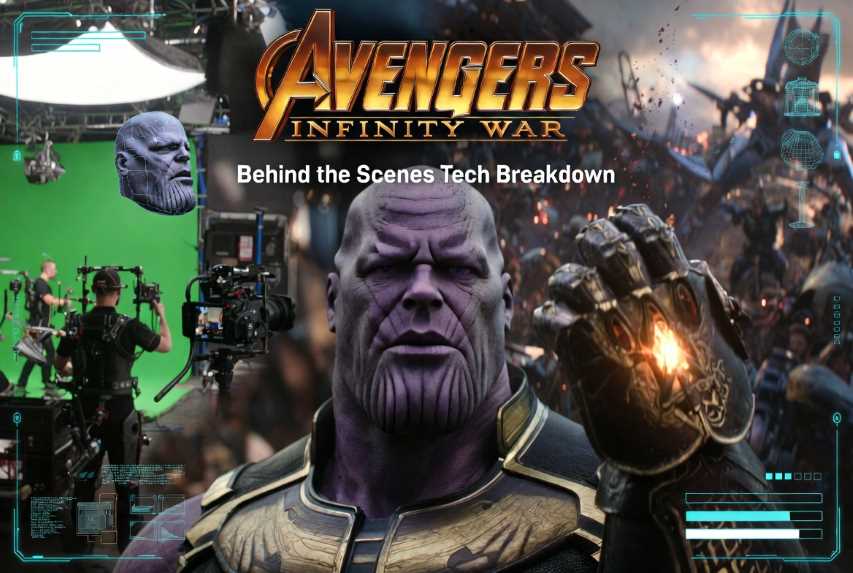
The VFX Magic That Turned a 2018 Blockbuster into a Visual Masterpiece
Avengers: Infinity War, released in 2018 and directed by Anthony and Joe Russo, stands as one of the most ambitious superhero films ever made from a technical standpoint. It brought together dozens of characters from across the Marvel Cinematic Universe into a single cohesive story while delivering jaw-dropping visuals on an epic scale. The film featured more than 2,680 visual effects shots, representing roughly 90% of its runtime — a staggering number that required coordinated efforts from multiple top-tier VFX studios worldwide.
This technical breakdown explores how filmmakers and artists used cutting-edge tools, performance capture innovations, massive simulations, and seamless integration of practical and digital elements to create unforgettable moments. From the terrifying presence of Thanos to the chaotic large-scale battles, Infinity War pushed the boundaries of what was possible in blockbuster filmmaking at the time.
Overall VFX Stats & Pipeline
The sheer volume of work demanded an incredibly organized global pipeline. Principal photography wrapped, but post-production involved constant iteration because the film was shot back-to-back with its sequel, Avengers: Endgame. This allowed studios to share assets, models, and even animation data efficiently.
Total VFX shots: Approximately 2,680.
Lead VFX Supervisor: Dan DeLeeuw, who oversaw the entire Marvel effort and ensured consistency across all sequences.
Major contributing studios and their primary responsibilities:
| Studio | Key Contributions | Approximate Shots Handled |
|---|---|---|
| Digital Domain | Main Thanos character development and performance | 400+ |
| Industrial Light & Magic (ILM) | Wakanda battle, final sequences, crowd work | Largest share |
| Weta Digital | Titan battle sequences, additional Thanos shots | Hundreds |
| Framestore | Opening New York scenes, Q-Ship, Ebony Maw creatures | 253 |
| Cinesite, DNEG, Lola, and others | Supporting environments, creatures, and enhancements | Remaining workload |
The production heavily relied on pre-visualization (previs) created months in advance to plan complex action beats. On-set post-visualization (postvis) teams adjusted shots in real time during filming. Unlike many earlier MCU films that relied heavily on pure green-screen stages, Infinity War mixed practical locations and sets with digital extensions. This hybrid approach helped actors deliver more natural performances while giving directors better real-time feedback.
Rendering farms ran around the clock across multiple continents, processing terabytes of data daily. The goal was always photorealism — making audiences forget they were watching digital creations.
Creating Thanos: From Actor Performance to Full CGI Titan
Thanos, portrayed by Josh Brolin, is entirely computer-generated. Standing over eight feet tall with a muscular purple physique, he required groundbreaking techniques to feel emotionally present and physically imposing alongside live actors.
Brolin performed in a full motion-capture suit covered in tracking markers. Dozens of high-speed cameras surrounded practical sets so other actors could look at and react to him in real space rather than empty air. For facial performance, Brolin wore a specialized helmet equipped with two high-definition cameras capturing his expressions at 60 frames per second, tracking around 150 markers on his face.
Digital Domain developed a proprietary machine-learning tool called Masquerade specifically for this project. It dramatically improved facial solving accuracy by learning from previous performances and reducing manual cleanup time. Weta Digital complemented this with an “actor puppet” workflow: they first built an ultra-photoreal digital double of Brolin’s actual face, captured his performance on that model, then carefully transferred the emotional nuances onto the final Thanos head. This hybrid method preserved micro-expressions and subtle acting choices that made Thanos feel alive and menacing rather than cartoonish.
Additional challenges included realistic skin shaders that responded correctly to lighting, detailed muscle and vein simulations under the skin, and cloth/hair dynamics on his armor and cape. Every close-up required multiple layers of subsurface scattering, specular highlights, and environmental reflections to match the surrounding live-action plates perfectly.
Iconic Sequences & Technical Breakdowns
Opening Act – New York Sanctum and Q-Ship (Framestore) The first 20 minutes alone contained over 250 VFX-heavy shots. Artists built a complete digital extension of New York City, complete with accurate building reflections and atmospheric haze. The Q-Ship interior was a mix of practical set pieces and full CG environments. Creatures like Ebony Maw and Cull Obsidian required detailed rigging, muscle simulations, and cloth dynamics. Iron Man’s bleeding-edge nanotech suit featured complex layered Houdini simulations that blended organic flowing metal with mechanical armor transformations.
Battle on Titan (Primarily Weta Digital) This sequence presented enormous environmental and lighting challenges. The barren, destroyed planet surface was almost entirely digital. Artists simulated dynamic dust storms, shifting rocky terrain, and realistic sunlight bouncing that changed constantly during the fight. Character integration was critical — heroes like Doctor Strange, Iron Man, and Spider-Man had to interact convincingly with the environment while performing complex combat choreography. Massive debris simulations and energy effect layers added to the sense of scale and danger.
Wakanda Battle – The Epic Siege (ILM) The film’s emotional and visual climax. Filmmakers used approximately 70 real stunt performers on treadmills and motion bases in front of green screens. These performances were then multiplied into thousands using advanced crowd simulation systems. The Outriders — Thanos’ alien army — were procedurally generated with individual variations in movement, damage states, and behavior. ILM’s artists ran enormous rigid-body simulations for falling trees, exploding terrain, and scattering debris. Cloth, hair, and armor simulations on hundreds of characters ran simultaneously, requiring powerful render farms and careful optimization.
Additional layers included atmospheric effects like smoke, dust, volumetric lighting through the trees, and distant city destruction. The final battle sequence blended all these elements so seamlessly that most viewers never realize how much of what they see was created digitally.
The Snap: Particle Disintegration Masterclass
One of the most memorable moments in cinema history — Thanos snapping his fingers and causing half of all life to disintegrate into dust — relied on sophisticated particle and simulation work. Artists created custom particle systems that responded to wind, gravity, and individual character lighting. Each disintegration included multiple layers: skin turning to ash, clothing collapsing, subtle glowing embers, and fine dust scattering realistically.
The effect had to feel both beautiful and tragic. Lighting, color timing, and sound design were synchronized precisely with the visual disintegration. Different characters required unique variations — some crumbled quickly, others slowly faded — adding emotional weight to each moment.
Key Tools & Technical Innovations
The production used industry-standard software pushed to new limits:
Maya for primary modeling, rigging, and animation.
Houdini for complex simulations including cloth, hair, destruction, crowds, and nanotech effects.
Nuke for final compositing, combining dozens of render passes per shot.
RenderMan and Arnold as primary render engines, handling billions of light rays across massive farms.
Custom machine-learning tools for facial capture and crowd variation.
Innovations included real-time on-set motion capture integration, improved subsurface scattering shaders for skin, and hybrid digital/physical lighting references that helped match CG elements to practical plates.
Major Challenges & Industry Impact
Coordinating multiple studios across time zones created communication and consistency challenges. Asset sharing pipelines had to be flawless so that a Thanos model from Digital Domain matched perfectly with environments from ILM or Weta. The sheer computational requirements pushed hardware and software development forward. Many techniques refined during Infinity War later influenced virtual production methods used in subsequent films and even game engines.
The film also raised the bar for performance capture in blockbuster cinema, proving that fully digital characters could carry emotional weight when the underlying acting and technology aligned perfectly.
Avengers: Infinity War remains a landmark achievement in visual effects history. It demonstrated that massive scale and emotional storytelling could coexist when supported by thoughtful pipelines, talented artists, and relentless technical innovation. The film’s success opened doors for even more ambitious projects and continues to serve as a reference point for VFX supervisors today.
The techniques pioneered here — from advanced facial capture to massive crowd simulations — influence not only movies but also video games, virtual reality experiences, and real-time rendering applications. Whether you’re a film fan, aspiring digital artist, or technology enthusiast, Infinity War offers countless lessons in how creativity and computation can create something truly unforgettable.
 |  |  |
 |  |  |