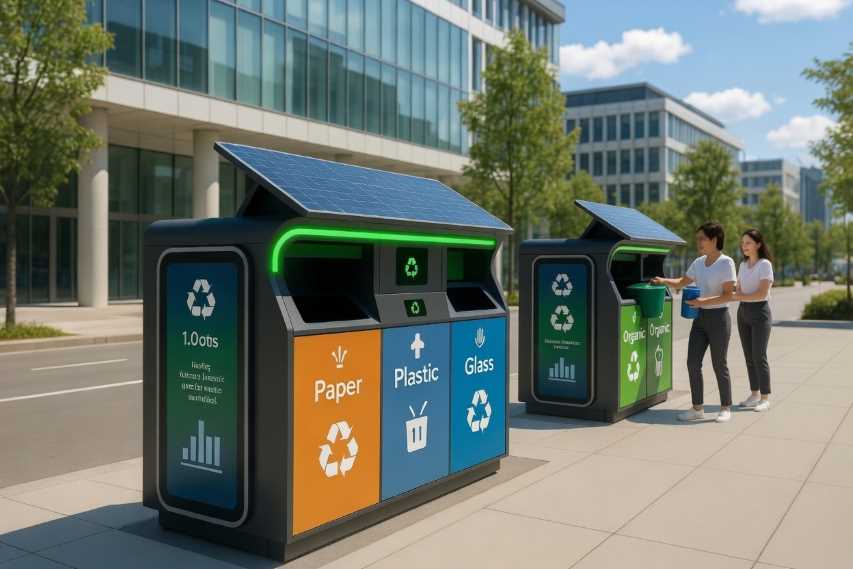
Imagine a city where public bins do more than just collect trash. They sort recyclables from non-recyclables, alert collection teams when full, and even recognize and reward citizens who dispose of their waste correctly. This is the concept of Smart Street Recycling and Sorting Bins – a critical innovation in the drive toward zero-waste cities and a cleaner, more sustainable urban environment.
These intelligent bins combine the Internet of Things (IoT), artificial intelligence, robotics, and cloud connectivity to transform street-level waste collection from a passive, inefficient process into a dynamic, data-driven system. Below, we explore every aspect of this technology in detail.
What Is a Smart Street Recycling & Sorting Bin?
A Smart Street Recycling Bin is a public waste receptacle equipped with sensors, connectivity, and often an internal sorting mechanism. Unlike a standard bin that holds mixed waste destined for landfill or costly manual sorting, a smart bin can:
Identify and separate different material types (plastic, metal, glass, paper, organic waste) using AI-powered cameras and sensors.
Communicate its fill level and operational status to a central waste management platform in real time.
Compact waste internally to increase capacity and reduce collection frequency.
Provide user feedback via screens, lights, or a mobile app to encourage correct recycling behavior.
Operate autonomously on solar power, making them suitable for parks, streets, transit hubs, and public squares.
These bins are a cornerstone of smart city ecosystems, bridging the gap between citizens, municipal services, and sustainability targets.
Core Technologies Powering Smart Sorting Bins
🔹 Artificial Intelligence & Computer Vision
An HD camera inside the bin captures an image of the item as it’s deposited.
A trained neural network identifies the material type, shape, and recycling category in milliseconds.
If the bin has multiple compartments, a robotic mechanism or a system of flaps directs the item into the correct internal container (e.g., plastic, aluminum, paper, general waste).
The AI constantly improves through machine learning, adapting to regional packaging variations and reducing mis-sorting over time.
🔹 IoT Sensors and Connectivity
Ultrasonic or infrared fill-level sensors in each compartment measure the available volume with precision, typically to within 1–2 centimeters.
Temperature and humidity sensors detect fire risks or organic decomposition that might indicate contamination.
Vandalism and tilt sensors trigger an alert if the bin is knocked over or tampered with.
Connectivity is via 4G/5G, NB-IoT, or LoRaWAN networks, chosen for low power consumption and long-range urban coverage.
🔹 Internal Compaction and Storage
Some bins incorporate a solar-powered compactor that presses down waste when a certain fill threshold is reached, increasing capacity by 5–8 times.
Compartments are modular and can be customized to match local recycling streams (dual, triple, or quad streams).
🔹 User Interface and Engagement
A touchscreen or e-ink display shows real-time bin status, recycling instructions, and even localized environmental tips.
LED light rings turn green for successful sorting, red for mistakes, creating instant behavioral feedback.
Some bins integrate with a reward system: users scan a card or phone app, correctly deposit an item, and earn points or credits.
🔹 Renewable Power Systems
Roof-mounted solar panels charge an internal battery, making the bin fully off-grid and energy-autonomous.
Power is managed intelligently to prioritize compaction, connectivity, and AI processing without interruption.
How the Sorting Process Works – Step by Step
User Approaches the Bin
A person walks up to the bin with an item – say, a plastic water bottle.
Item Introduction
The bin may have a single deposit slot, with the user prompted to place the item inside. Some bins scan the item before it enters.
Recognition and Classification
The camera captures the item’s image. The AI engine classifies it as PET plastic (bottle), and checks for any residual liquids or contaminants. Simultaneously, metal sensors might confirm the absence of ferrous/non-ferrous metals.
Sorting Decision
A robotic gate or a rotating drum directs the bottle into the plastics compartment. If the bin has a compactor, it may be activated later once that compartment reaches a set level.
Confirmation and Data Log
The bin’s screen shows a green checkmark and thanks the user. The event is logged: time, material type, approximate weight (if load cells are present), and fill-level increment. This data is sent to the cloud dashboard.
Key Features and Benefits for Cities and Citizens
Feature | Description | City Benefit | Citizen Benefit |
|---|---|---|---|
| Real-time Fill Monitoring | Each compartment reports its fill level continuously. | Dynamic route optimization for collection trucks; fuel and labor savings up to 40%. | No overflowing bins, reduced litter and odor. |
| Automatic Sorting at Source | AI-driven separation of recyclables without user decision. | Drastically reduces contamination rates in recycling streams; preserves material value. | Simple one-hole deposit – no confusion over which bin to use. |
| Waste Compaction | Built-in solar compactor. | Up to 5x more waste per bin; fewer collections needed. | Less visual clutter and frequent truck disturbance. |
| Data Analytics Dashboard | Cloud platform aggregates all bin data: fill trends, material breakdown, peak usage times. | Data-driven placement of bins, infrastructure planning, and public education campaigns. | Indirect: improved service and city cleanliness. |
| Public Education & Gamification | Screens show what can and can’t be recycled; rewards for correct disposal. | Higher recycling rates and lower cleanup costs; fosters a culture of sustainability. | Tangible rewards, feeling of contribution, clearer guidance. |
| Solar-Powered & Off-Grid | No need for electrical infrastructure. | Lower installation and operating costs; zero carbon emission from power. | Consistent operation even during grid outages. |
| Odor and Pest Control | Sealed compartments, often with carbon filters. | Fewer public complaints, less vermin. | More pleasant experience near the bin. |
Real-World Deployments and Examples
🗑️ Bin-e – AI Sorting Office & Public Bin (Poland)
Bin-e is one of the first AI-powered bins that automatically sorts waste into four categories. Used in offices and public spaces, its camera recognizes the item and opens the correct internal container. A cloud dashboard gives facility managers a detailed breakdown of waste generation, helping them meet sustainability certifications.
🗑️ Bigbelly Solar Compactors (USA, Worldwide)
Bigbelly stations are widely deployed in streets and parks in cities like New York, Boston, and Amsterdam. While earlier models focused on compaction and fill-level alerts, newer versions include a separate recycling module and are experimenting with AI cameras for contamination detection.
🗑️ Ecube Labs – CleanCUBE & CleanFLEX (South Korea)
Ecube’s solar-powered compacting bins use ultrasonic sensors and a cloud platform for route optimization. The CleanFLEX model adds a recycling segregation unit with multiple compartments, designed for high-footfall city areas.
🗑️ TrashBot by CleanRobotics (USA)
TrashBot is specifically designed for high-traffic indoor spaces like airports and malls. It uses AI, sensors, and a robotic conveyor system to sort items placed into a single opening with 90%+ accuracy, then deposits them into the appropriate bin inside. It also provides real-time analytics on waste stream composition.
🗑️ Singapore’s Smart Recycling Bins
In Singapore, public smart recycling bins have been trialed with weight sensors, fill monitoring, and user reward schemes tied to the national “Reverse Vending” ecosystem. Citizens can deposit used beverage containers and receive credits.
The Technology Stack in Depth
A typical smart sorting bin operates on a layered architecture:
Perception Layer (Sensors & Actuators)
Camera module (RGB, sometimes infrared for night use).
Metal detector (inductive proximity sensor).
Load cell for weight measurement.
Fill-level ultrasonic sensors per compartment.
Temperature, humidity, and gas sensors.
Motorized flaps or a rotating sorting plate.
Edge AI Processing Unit
An onboard processor (often a low-power GPU or FPGA) runs the object recognition model locally, minimizing latency and ensuring data privacy.
The sorting decision is made within 100–300 milliseconds.
Connectivity Module
4G/5G or LPWAN (NB-IoT/LoRaWAN) for periodic data transmission.
BLE (Bluetooth Low Energy) for direct interaction with a user’s smartphone.
Cloud Platform & Data Management
Ingesting and storing all bin events.
Dashboard for waste managers: map view, fill-level heatmaps, collection schedules, contamination alerts.
APIs to integrate with city-wide waste management systems and smart city platforms.
User-Facing Applications
Mobile app for citizens: find nearest bin, check if it’s full, review recycling history, redeem rewards.
Public display API to show environmental impact stats (e.g., “This bin saved 12 kg of CO₂ this week”).
Security & Maintenance
Encrypted data links, remote firmware updates, and self-diagnostics.
Anti-vandalism alerts and tamper-proof design.
Challenges and Considerations
Despite the immense promise, deploying smart sorting bins at scale comes with hurdles:
High Capital Cost: Each unit is significantly more expensive than a standard public bin due to sensors, AI hardware, and the mechanical sorting system. The ROI depends heavily on reduced collection costs and material recovery value.
Contamination and User Error: Even with AI, if a user deposits a half-full coffee cup, the AI might misclassify the material or the liquid can contaminate other items. Designing for "messy" real-world behavior remains a challenge.
Maintenance and Reliability: Mechanical components like flaps and compactors are prone to wear, especially in outdoor environments with dust, sand, and extreme temperatures. Units must be easily serviceable.
Power Autonomy: Solar panels need sufficient daily sunlight; in shaded streets or long winters, battery capacity and efficient power management become critical.
Data Privacy: Cameras inside bins capture images of waste, but some designs may inadvertently capture a user’s reflection or surrounding activity. Clear privacy policies and on-device processing (no raw image transmission) are essential.
Public Behavior Change: Technology alone cannot make people recycle properly. The user interface must be intuitive, and public education campaigns are necessary to drive adoption.
Integration with Existing Waste Streams: The separated materials must align with the downstream recycling infrastructure. If the city’s MRF (Materials Recovery Facility) cannot process a particular material separately, the bin’s sorting effort may be wasted.
The Future of Smart Street Bins
Smart recycling bins are evolving rapidly. Here’s what the next generation will bring:
Hyper-Personalized Feedback: Bins will recognize returning users (via an opt-in app or fob) and provide customized tips based on their recycling history, turning waste disposal into a gamified, habit-forming activity.
Autonomous Bin Robots: Instead of stationary bins, small autonomous robots will roam pedestrian zones, approaching people and accepting recyclables, thus maximizing convenience and capture rates.
Blockchain-Verified Recycling Credits: Each successful sort will be recorded on a tamper-proof ledger, allowing cities to issue tokenized rewards or even carbon credits that can be traded or used for public transport.
Multimodal Sorting with Spectroscopy: Beyond visible-light cameras, bins will use near-infrared (NIR) spectroscopy to identify plastic polymer types (PET vs. HDPE vs. LDPE) with near-100% accuracy, enabling true separation at the point of disposal.
Predictive Behavioral Nudges: Using city-wide data, bins will communicate with digital signage or push messages to a citizen’s phone, nudging them to use a nearby bin when they enter a hotspot, reducing litter.
Circular Economy Integration: Smart bins will become the first node in a local micro-recycling factory – imagine a bin that grinds and cleans PET bottles on the spot, producing flakes ready for 3D printing filament.
Smart Street Recycling and Sorting Bins represent a paradigm shift from passive waste collection to active resource recovery. By embedding intelligence directly into the first point of disposal, cities can dramatically reduce contamination, optimize collection logistics, and engage citizens in a tangible way. While challenges around cost and maintenance remain, the technology is maturing fast and being proven in deployments worldwide.
The bin is no longer just a bin. It is a data node, an educator, a compactor, and a sorter all in one – a silent yet powerful agent in the journey toward truly circular, zero-waste cities. As these systems become more common, the simple act of throwing something away will become a measurable, meaningful contribution to a cleaner planet.
 |  |  |
 |  |  |